
Theater seating vs auditorium seating is a question we get every week, usually from someone holding two very similar quotations. The two ranges look alike in a photograph. In practice they differ in height, in back shape, in what the armrest carries and in how they meet the floor. We make both in İstanbul, so this comparison uses our own dimensions rather than generic ones.
This article compares the two product types. For the plan of the room itself, see our guide to auditorium seating layout. For the floor and the fixings, see auditorium seating installation.
Theater seating vs auditorium seating: the short answer
Cinema and theatre seats are built for watching. Auditorium and conference seats are built for watching, listening and working.
That single difference explains almost everything else. A cinema seat stays low, so the row behind can see over it. A conference seat stands taller, because it supports the head and often carries a writing tablet. As a result the two ranges rarely swap places, even though they share a frame family.
We currently build 11 cinema and theatre models and 12 auditorium and conference models. Both ranges use the same steel seat frame, the same foam and the same finishing options.
Height and back shape: the visible difference
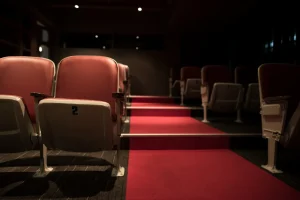
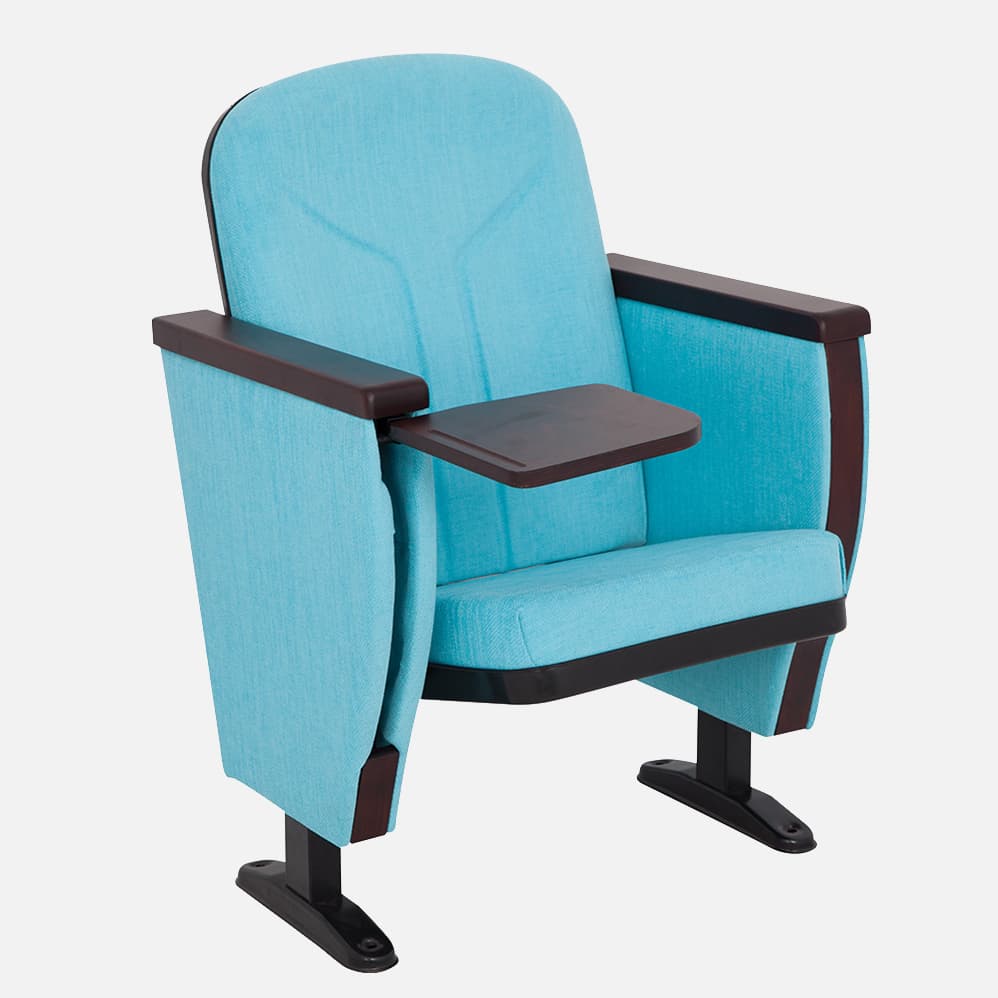
Height is the fastest way to tell the two apart. Our cinema models stand about 88 cm from the floor. Our auditorium models run from 96 cm to 102 cm.
Those extra 8 to 14 centimetres are all back. A taller back supports the shoulders and head, which matters over a three-hour conference but not over a film. Meanwhile the lower cinema back keeps the sightline clean without forcing a steeper floor.
Seat width stays similar in both ranges, at 45 to 47 cm inside a 62 cm arm-to-arm module. Therefore switching between the two ranges does not change your seat count. It changes the feel of the room, and the rake you need.
The armrest does different work
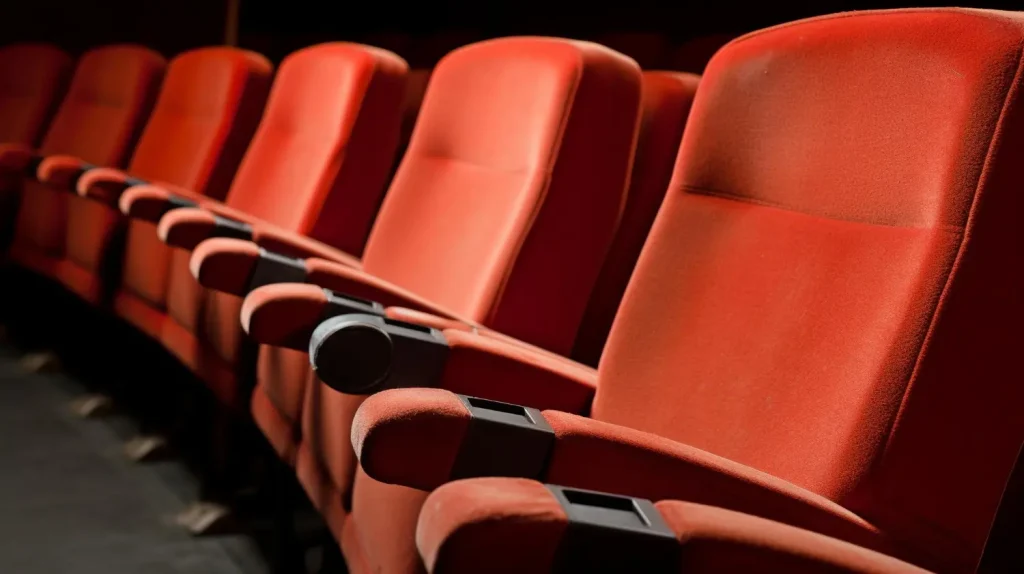
In a cinema, the armrest is a shared surface and often a cup holder. In a conference hall it is a mounting point.
Most of our auditorium models can take a writing tablet on the armrest. The tablet uses an anti-panic mechanism, so it folds away by itself if the room has to empty quickly. That single feature drives several decisions: the row needs more depth, the armrest needs a stronger section, and the seat has to sit level.
Both ranges use a solid wood top on the armrest, with MDF side covers. So the visible finish is the same. Only the load path underneath changes.
What is identical in both ranges
Buyers often assume cinema seating is built lighter. In our case it is not.
Both ranges share a steel seat frame in 19 × 1.20 × 2.5 mm section. The foam runs at 50 to 55 kg per cubic metre, which is a contract density rather than a domestic one. Beechwood appears in the same two places: the backrest and the panel under the seat. Moving parts use PPC plastic in either range, so the mechanism does not corrode.
Fire performance matches as well, to class B. Because the specification underneath is shared, the theater seating vs auditorium seating choice really comes down to posture, height and mounting.
The tip-up mechanism and why it matters
Every fixed seat we make tips up. The seat pan folds towards the back, which clears the row so people can pass.
Cinema mechanisms are usually tuned to return slowly and quietly, since a slamming seat is audible during a film. Conference mechanisms return more firmly, because a half-open seat blocks a busy row between sessions.
Either way, the mechanism adds depth. That is why fixed seating needs 90 to 100 cm between rows rather than the 85 to 90 cm we use for loose chairs. We work through those figures in the layout guide.
How each type meets the floor
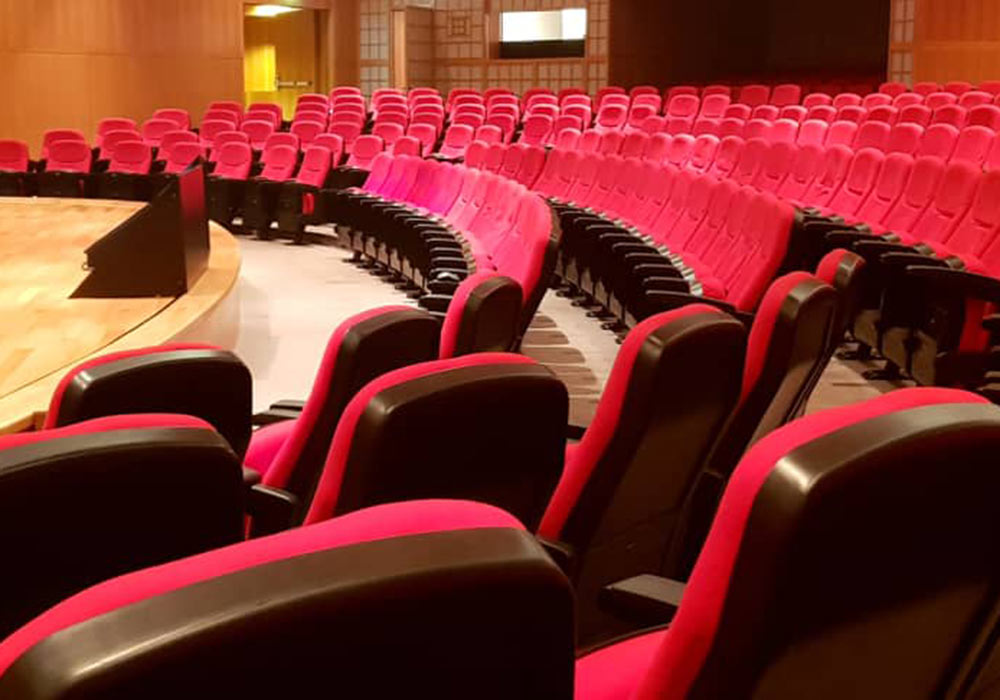
Cinema seating almost always sits on steps. Each row has its own level, and the seat anchors into the tread near the riser face.
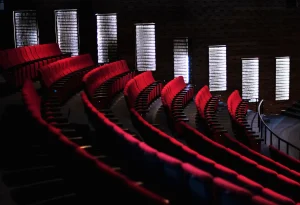
Auditorium seating more often sits on a gentle rake or a flat floor. On a rake the seat needs a wedge or an adjustable foot, so that the seat pan stays level while the floor slopes. On a flat floor the fixing is simple, yet the sightline work gets harder.
Neither arrangement is better. However, they are not interchangeable at the last minute, since the foot detail is made to the floor. The installation guide covers anchors, tolerances and the survey we ask for.
Cost per seat: where the money goes
People expect the taller seat to cost more, and usually it does. Still, the gap is smaller than most buyers assume, because the shared frame and foam carry much of the cost.
Three things move the price more than the range does. First, upholstery: fabric grade changes the seat price far more than back height. Second, the writing tablet, which adds parts and labour. Third, the mounting detail, since a stepped floor needs different feet from a raked one.
In short, specify the fabric and the tablet before you compare two quotations. Otherwise you are comparing two different products with the same name.
Which one belongs in your room
Choose cinema and theatre seating when people come to watch, when the floor is stepped, and when the screen is large and low. Our cinema and theatre seating range covers that case.
Choose auditorium and conference seating when sessions run long, when delegates take notes, and when the room also hosts lectures or ceremonies. Our auditorium and conference seating range is built for it.
Mixed rooms exist too. A university hall may want tablets at the front and plain seats at the back, and that mix is straightforward to build. If the room has to clear completely for dinners or exams, then the theater seating vs auditorium seating question does not apply at all, and stackable banquet chairs are the honest answer.
Where to go from here
Once you settle theater seating vs auditorium seating, the next question is the grid. Our auditorium seating layout guide gives spacing, sightlines and a worked capacity example.
If the room is already drawn, send us the plan through the contact page. We will return a seating layout, a model recommendation and a written quotation.
Frequently asked questions
Is theater seating cheaper than auditorium seating? Usually a little, because the back is shorter. Fabric grade and the writing tablet change the price far more than the range does.
What is the main difference in theater seating vs auditorium seating? Height and purpose. Cinema seats stay around 88 cm so people see over them, while conference seats reach 96 to 102 cm and support longer sessions.
Can cinema seats be used in a lecture hall? They can, but delegates will notice. The lower back gives less support over long sessions, and most cinema models do not take a writing tablet.
Do both types tip up? Yes. Every fixed model we build has a tip-up seat, and the mechanism sits inside a corrosion-resistant plastic housing.
Are the seat widths the same? Effectively yes. Both ranges work to a 62 cm arm-to-arm module, so your seat count per row does not change when you switch.
Can we mix the two ranges in one room? Yes, and it is common. Keep the arm-to-arm module identical so the rows still line up.