
Buying banquet tables looks simple until the first quotation lands and every line reads differently. One supplier prices a 180 cm round, another a 71-inch, a third quotes the same top on three frame grades. Banquet tables are not a commodity, whatever the price list implies. Most of the confusion comes from the fact that nobody sells you a table; they sell you a top, a frame and an edge, and those three parts fail at different speeds. This guide walks through each decision the way we walk a buyer through it on the factory floor in Istanbul, where we also build the banquet chairs that sit around these tables.
Quick answer
Banquet tables are commercial folding tables built for repeated setup in hotels, halls and conference venues. Most venues need 180 cm (71 inch) rounds for dining, 6 foot rectangulars for buffets and classrooms, and a smaller run of cocktail tables. Judge them by frame gauge, top substrate and edge banding.
What banquet tables are, and why the category confuses buyers
A banquet table is a commercial folding table designed to be set, cleared and stored many times a week. That sounds obvious. Yet the term covers everything from a plastic picnic top to a 30-kilogram laminated conference table. Commercial banquet tables sit at the heavier end.
The confusing part is that banquet tables rarely stay in one configuration. A hotel ballroom might run a wedding on Saturday with thirty rounds, then break the room down for a Monday conference using the same footprint in rectangulars. So the product has to survive two jobs at once: it must look presentable under linen, and it must tolerate being folded, wheeled and stacked by staff who are in a hurry.
Because of that dual life, the failure points on banquet tables are predictable. Tops delaminate at the edge where trolleys knock them. Leg mechanisms loosen where the rivet meets thin steel. Feet scratch floors once the plastic caps wear through. None of these appear in the first six months, which is exactly why cheap banquet tables win so many tenders.
Another source of confusion is naming. Some markets say banquet table, others say catering table, folding table or trestle. They often mean the same product. Meanwhile a “banquette” is a fixed upholstered bench, and search results mix the two. When you brief a supplier, describe the use rather than the label.
Throughout this guide we treat banquet tables as contract furniture rather than as a purchase to be optimised on price alone. That distinction changes what you inspect and what you refuse to accept. It also changes who you buy from, since a trader cannot answer the questions that follow.
The main banquet tables types you will be quoted
Most suppliers build banquet tables from a short list of shapes. Knowing the list makes quotations comparable, because you can force every vendor onto the same grid. Without it you end up comparing a round top against a rectangular frame and learning nothing.
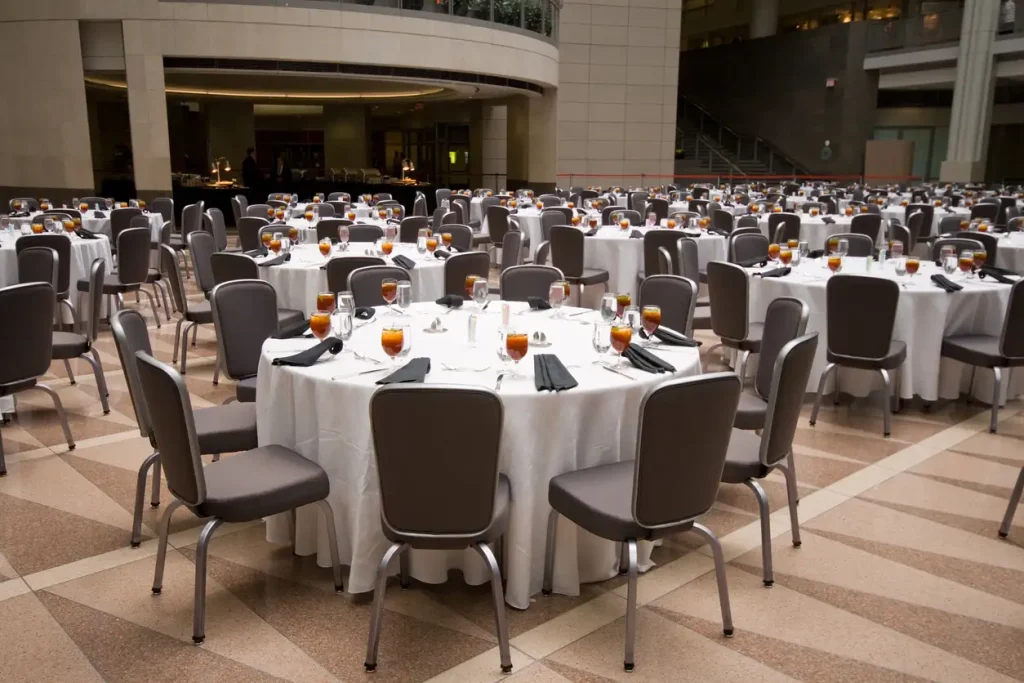
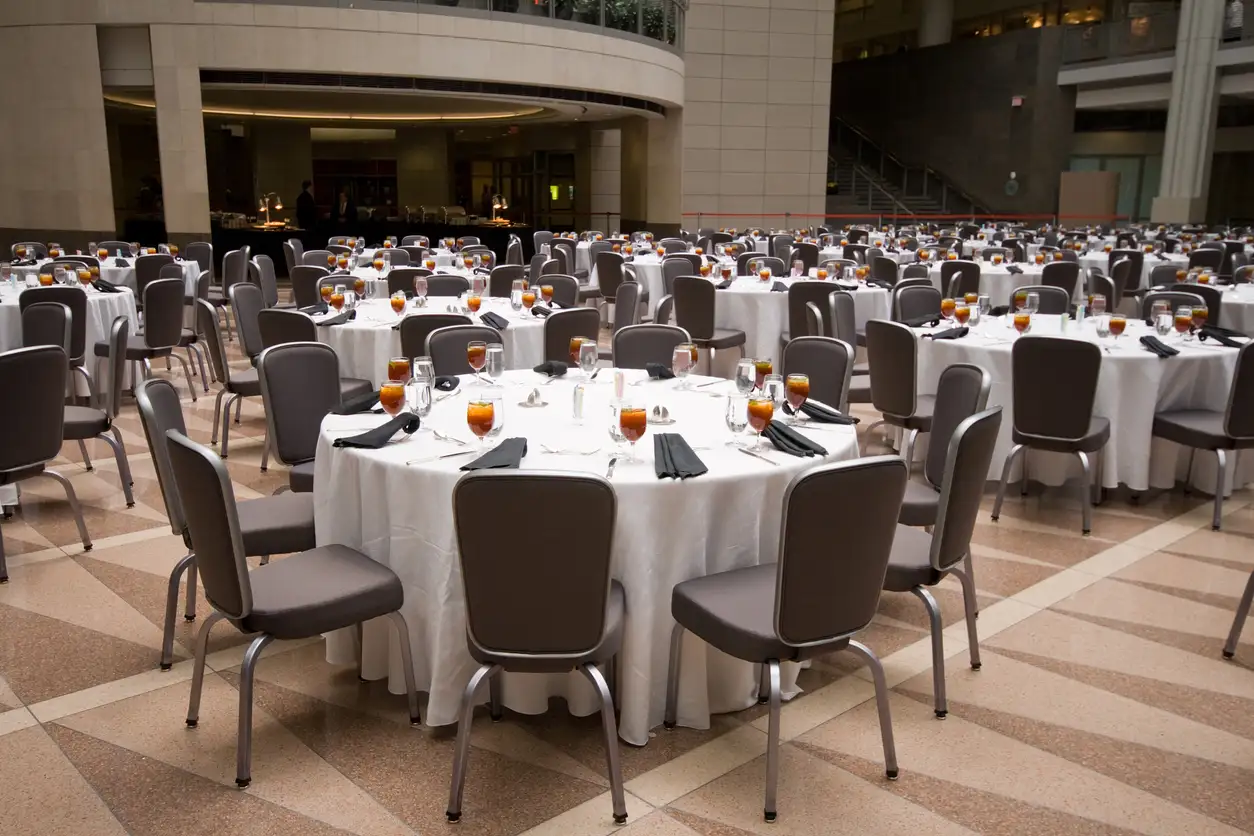
Round banquet tables carry dining service. They dominate weddings, gala dinners and any event where guests talk across the table rather than along it. Diameters run from 100 cm up to 200 cm, or roughly 40 to 79 inches, and the jump between sizes changes the guest count far more than buyers expect.
Rectangular banquet tables handle everything else. Buffets, registration desks, classroom layouts, back-of-house prep and exam halls all run on rectangulars. They stack better than rounds and they fold flatter, so venues with tight storage often over-buy them deliberately.
Then come the shaping pieces. Half-round tables close the end of a rectangular run. Quarter-rounds turn a corner. Serpentine sections curve a buffet line so it reads as designed rather than improvised. Venues rarely need many, but the few they own get used constantly.
Cocktail tables, sometimes called poseur or highboy tables, serve standing receptions. They are narrow, tall and light, and they usually arrive with a separate base rather than folding legs. Venues treat them as banquet tables even though they never seat anyone.
Finally there are conference tables with cable ports, which sit between banquet furniture and office furniture. We build them because meeting rooms ask for them, though they belong to a different duty cycle.
You can see all of these in our banquet and conference table range, which currently runs to fifteen models. Comparing shapes side by side is usually faster than reading three separate quotations.
Standard banquet tables sizes, in feet and centimetres
Buyers in different markets ask for the same table in different units, and quotations get mangled in translation. A “60 round” in the United States and a 152 cm round in Europe are the same product. Getting this straight before you brief a supplier prevents the most avoidable ordering error in the category.
The table below lists the sizes we actually build and the seat counts we quote against them. Read the diameter or length first, then the seat count, then the note. The note is where most of the useful information sits, because a number without context has caused more room-planning failures than any other figure in this business.
| Shape | Imperial | Metric | Seats | Typical use |
|---|---|---|---|---|
| Round | 48″ | 120 cm | 4–6 | Small dining, cafe layouts |
| Round | 60″ | 152 cm | 8 | Tight ballrooms, higher table count |
| Round | 71″ | 180 cm | 10 | The hotel standard for banquets |
| Round | 79″ | 200 cm | 12 | Large covers, harder to serve |
| Rectangular | 6 ft | 183 x 76 cm | 6–8 | Classroom, dining, general purpose |
| Rectangular | 8 ft | 244 x 76 cm | 8–10 | Long dining runs, imperial layouts |
| Rectangular | 6 ft narrow | 183 x 45 cm | — | Registration, buffet, service only |
| Cocktail | — | 60–80 cm dia. | Standing | Receptions, bar overflow |
Two figures in that table deserve a warning. The 8 foot rectangular seats ten only if you place guests at the ends, which most venues avoid because it blocks service. Plan for eight and treat ten as a squeeze. Likewise the 79 inch round technically seats twelve, but servers cannot reach the centre without leaning across guests.
Height is the one dimension that almost never changes. Banquet tables sit at 76 cm, or 30 inches, because that matches dining posture and standard chair seat height. Cocktail tables break the rule at around 110 cm for standing service. If a supplier quotes a dining height outside 74 to 78 cm, ask why before you accept it.
One practical note on units. Order in the unit your supplier manufactures in, then convert for your own records. A factory working in centimetres that receives an order in feet will round somewhere, and a five millimetre rounding across a joined run of banquet tables shows up as a visible step under linen. Put both figures on the purchase order and state which one governs.
Round banquet tables: diameters, seat counts and the aisle problem
Round banquet tables get specified by diameter, and the diameter decides the seat count. The relationship is not linear, so a small change in size moves the whole room plan. Get it wrong and you either lose covers or lose circulation.
A 152 cm round banquet table, the 60 inch size, seats eight comfortably. Push it to 180 cm and you seat ten. Go to 200 cm and you reach twelve, though servers struggle to reach the centre. Most hotels standardise on the 180 cm round because it balances covers against circulation.
Here is where buyers go wrong. They calculate seats, multiply by tables, and stop. Yet the aisle between banquet tables governs whether the room works. Banquet service needs roughly 150 cm, about 5 feet, between chair backs so two servers can pass. Squeeze that to 120 cm and service slows, guests get knocked, and the venue quietly stops using the layout.
So the real question is not how many guests fit on the table. It is how many banquet tables fit in the room once you protect the aisles. A ballroom that theoretically holds thirty rounds often runs twenty-six in practice.
Chair width matters too. A standard banquet chair is about 45 cm wide. Add armrests and you reach 65 cm, which removes a seat or two per table. Venues that buy armchairs for comfort sometimes discover they lost a full table of revenue per event.
One more practical point. Round banquet tables do not stack as tightly as rectangular ones, and a 180 cm round is awkward for one person to carry. If your team is small, plan trolleys from the start rather than buying them later. Storage geometry punishes rounds twice, once in the stack and once in the doorway.
Rectangular and trestle tables: the quiet workhorses
Rectangular banquet tables do more work than any other shape, yet they get the least attention in the specification. That imbalance costs venues money, because the tables that run every day wear out first.
The common sizes for rectangular banquet tables are 183 x 76 cm and 244 x 76 cm, sold in most markets as 6 foot and 8 foot banquet tables. A 45 cm deep version handles registration and buffet lines. Height sits at 76 cm, or 30 inches, matching dining posture. Depth is the number people forget: a 76 cm deep table seats guests on both sides, while a 45 cm table is a service surface only.
For classroom layouts, depth decides comfort. Delegates need somewhere to put a laptop, a notepad and a glass of water. At 45 cm they run out of room within an hour, and the complaint reaches the venue rather than the furniture supplier.
Buffet banquet tables have a different requirement. Chafing dishes are heavy and hot, so the top must resist point load and heat without blistering. Thin tops betray you here. A buffet table that sags after one season sits on an unsupported substrate.
Rectangulars also carry the back-of-house burden. They get used for plating, for linen sorting, for storage during a build. Nobody specifies them for that, but every venue does it. Buying two grades, a presentable set for front of house and a tougher set for back, usually costs less over five years than buying one middling grade for both.
Because they fold flat and stack in deep piles, rectangular banquet tables are the cheapest shape to store. Venues short on storage should shift their mix toward them wherever the event format allows. The saving shows up in floor area, in freight and in how quickly one person can reset a room.
Serpentine, half-round and quarter-round: shaping the room
Shaping pieces rarely appear in a first order of banquet tables. They appear in the second, once straight lines start to look unfinished.
A half-round banquet table closes the end of a rectangular run. Put two at either end of a buffet and the line reads as a single designed object rather than four tables pushed together. The visual difference is out of proportion to the cost.
Quarter-round banquet tables turn a corner cleanly. Without them, a buffet that changes direction leaves a triangular gap filled with a cloth and hope.
Serpentine sections curve. They are the most decorative banquet tables and the least practical to store, since the shape wastes space in a stack. Venues buy a small fixed number and treat them as a set piece.
There is a planning trap here. These shapes only work if they match the height, depth and edge profile of your rectangulars exactly. Mixing suppliers across years is how venues end up with a buffet that steps up by four millimetres halfway along. Under linen it looks like a fault in the floor.
So if you expect to extend later, record the model and edge profile of your straight banquet tables now. It costs nothing today and prevents a full re-order.
Risk insight
Mixing suppliers across reorders is the most common and most expensive banquet table mistake we see. Tops from different factories rarely match in height, thickness or edge radius. A four millimetre step along a buffet line is invisible in a photograph and obvious under linen. Once it happens, the only fix is replacing the whole run. Record the model code, the edge profile and the exact height of every table you own, and quote those numbers when you extend the set.
Tops: what is actually under the laminate
The top is the part guests touch and the part that decides how long banquet tables look acceptable. It is also where specifications get vague, because two identical-looking surfaces can hide very different cores.
Most commercial banquet tables use a wood-based core faced with high-pressure or melamine laminate. The core does the structural work. Our tops run 18 mm, which resists sag across a 180 cm span without a heavy underframe. Thinner cores exist, and they are cheaper, but they need more support underneath to reach the same stiffness.
Plastic tops are the other family. Blow-moulded polyethylene tops are light, waterproof and almost indestructible in a garden or a school hall. They also look like what they are, so most hotels keep them out of front of house. If you run outdoor events, though, they earn their place.
Laminate grade matters more than colour. A hard laminate resists the scratches that come from sliding cutlery trays and stacking chairs on tabletops, which staff will do no matter what the policy says. Ask for the laminate specification, not just the finish name.
Moisture is the quiet killer. Wood-based cores swell if water reaches the core through a damaged edge or an unsealed screw hole. Swelling is permanent. This is why the edge treatment, covered next, deserves more attention than it usually gets.
Finally, weigh handling against durability. An 18 mm laminated 180 cm round is a solid object. Staff manage it easily with a trolley and resent it without one. Match the top specification of your banquet tables to the team who lifts them, not to the specification sheet.
Edges: why the banding fails first
Ask any venue what went wrong with their last set of tables and the answer is usually the edge. It takes every trolley knock, every doorway, every careless stack.
The cheapest treatment is a thin PVC band glued to the core. It looks fine on delivery. Then a trolley catches a corner, the band lifts, and moisture reaches the core.
A better solution is a T-type impact rubber edge set into the top. The rubber absorbs the knock instead of transferring it to the glue line, and it protects the guest as well, since a rubber edge does not cut a hand or snag a dress. We fit this profile because our own service data kept pointing at edge damage rather than top damage.
Rounded corners help too. A square corner concentrates every impact into one point; a radiused corner spreads it.
Inspect the edge before you accept a delivery. Run a fingernail along the join. If you can feel a lip, the band was not pressed properly, and it will lift. If you can see glue squeeze-out, the line was run hot or fast. Both are visible in thirty seconds and both predict the table’s life.
None of this shows up in a photograph, which is why edge quality separates suppliers who make banquet tables from suppliers who simply resell them. A factory will describe the edge operation in detail. A trader will send you another picture of the top.
If you inherit an existing set, check the edges before you decide whether to replace or repair. Tables with sound frames and failed banding can sometimes be re-edged, which costs a fraction of replacement and buys several more seasons.
Frames and folding mechanisms: where the money goes
If the top decides how banquet tables look, the frame decides how long they last. It is also the part buyers understand least, because a folded table hides its own mechanism inside itself.
Our frames use a 28 x 1.2 mm steel tube with a ball-bearing locking mechanism, finished in electrostatic paint. Two numbers matter there. The 1.2 mm is wall thickness, and it governs whether the tube deforms when a leg takes a sideways knock. The ball bearing governs whether the lock still snaps shut after five thousand cycles.
Cheaper frames thin the wall and replace the bearing with a stamped catch. Both changes are invisible on delivery. Both show up in year two, when legs start folding under load and staff learn to kick them into place.
Paint matters more than it sounds. Electrostatic powder coating bonds to the steel and resists the chipping that leads to rust. A wet-sprayed frame chips at the first trolley contact, and rust follows moisture into the chip. In a humid ballroom or a coastal venue, that difference decides whether the frame survives a decade.
Feet complete the picture. Non-marking caps protect the floor, and they wear out. Ask whether replacement caps are available separately, because a table with worn feet damages a ballroom floor far more expensively than the table itself cost.
We will cover mechanism types in more depth in a dedicated guide, since the differences between wishbone, straight-leg and cross-brace folding deserve their own comparison. For now, the rule is simple: ask for the tube gauge and the lock type in writing.
Weight, stacking and the storage maths
Storage quietly shapes every banquet furniture decision, and banquet tables are the bulkiest item in the inventory.
Rectangular banquet tables fold flat and stack vertically on a trolley, which is why venues can hold large numbers in a small footprint. Rounds are harder. A 180 cm round folded is still 180 cm tall, so it stores on edge and needs a purpose-built trolley to move safely.
Run the numbers before you order. A store room holding forty folded rectangulars might take only twenty-four rounds in the same area.
Trolleys are not an accessory for banquet tables. One person can move eight to ten folded tables on a trolley. Without one, the same job needs two people and takes four times as long, and the tables get dragged rather than carried. We build table and chair trolleys in the same catalogue precisely because the storage plan fails without them.
Floor protection matters too. Non-marking wheels matter as much as non-marking feet. A ballroom refinish costs more than the trolleys that would have prevented it.
Finally, plan for the peak, not the average. Venues size storage for their normal event and then discover that the annual gala needs every table out at once, with nowhere to put the ones not in use. Leave headroom.
Cost insight
Trolleys usually cost under five per cent of a table order and change the labour cost of every event afterwards. Moving folded tables by hand takes two staff; a trolley makes it one, and cuts a typical ballroom reset from around ninety minutes to roughly thirty. For a venue running three events a week, that saved labour outweighs the trolley cost within the first season. Buy them with the tables, not after the first complaint.
How many banquet tables a venue actually needs
This is the question every buyer asks and almost every supplier answers badly. How many banquet tables you need depends on the event mix rather than on the room size, and the two rarely match.
Start with your largest realistic dining event. Divide the guest count by ten for 180 cm rounds, or by eight for 60 inch rounds. A hundred guests therefore needs ten of the larger banquet tables, and four hundred needs forty. That is your dining baseline.
Then add the service layer. Buffet lines, registration, gift tables, cake tables and back-of-house prep typically add fifteen to twenty per cent on top of the dining count in rectangulars. Venues that skip this end up cannibalising dining tables for service, which leaves the room short.
Now add breakage and rotation. Banquet tables come out of service for repair, for deep cleaning, or because a linen order did not arrive. A working spare rate of around five per cent keeps the room running without emergency hire.
Cocktail banquet tables follow a different logic entirely. Standing receptions need roughly one poseur per eight to ten guests, and they get used in far more configurations than people expect, including as registration points and bar overflow.
One caution about over-ordering. Every extra table needs storage, linen and maintenance for its whole life. Buying twenty per cent more banquet tables than you need is not a safety margin; it is a recurring cost that never stops. Size for the real peak, add the spare rate, and stop there.
Write the calculation down. When the venue changes hands or the operations manager moves on, the reasoning behind the quantity is usually the first thing lost.
Standards, load ratings and what to ask for
Commercial banquet tables sit under published standards, and quoting them changes the conversation with a supplier immediately.
The relevant European standard for this category is EN 15372, which covers strength, durability and safety requirements for non-domestic tables. It defines the tests a commercial table should survive, including vertical and horizontal load, drop tests and stability. You can read the scope on the BSI listing for EN 15372.
Asking whether a table is tested to that standard tells you a lot, and not only from the answer. A manufacturer who tests will say which level and which laboratory. A trader who buys anonymous stock usually cannot answer at all.
Load rating on banquet tables deserves a separate question. A buffet table carrying three chafing dishes and a water urn is under a very different load from a dining table carrying plates. Ask for the rated distributed load and the point load, and ask where the rating was measured, because a centre-span figure and an over-leg figure are not comparable.
Fire behaviour matters for some venues, particularly where local regulation covers public assembly spaces. Tables are less exposed than upholstered seating, but if your venue is regulated, put the requirement in the tender rather than discovering it at inspection.
Finally, ask what happens after the sale. Banquet tables rated for ten years but sold without spare parts are five-year tables in practice. Confirm that feet, locks and edge sections can be bought separately, and confirm it in writing.
Warranty wording repays a careful read as well. A warranty covering manufacturing defects only, with no cover for mechanism wear, tells you what the manufacturer expects to fail.
Linen, or how to avoid buying it forever
Linen is not furniture, yet it shapes furniture decisions more than any other factor, because it is a recurring cost attached to a one-off purchase.
Every banquet table size you own needs its own cloth size, and every cloth needs laundering after every use. So a venue that buys four different round diameters has quadrupled its linen inventory before a single guest arrives. Standardising on two round sizes instead of four can cut linen spend dramatically.
That is the strongest argument for a disciplined size list. It is also why suppliers who cheerfully quote nine different diameters are not doing you a favour.
Linenless banquet tables are the alternative. A table finished to be seen, with a decorative top and a clean edge, removes the cloth entirely for conferences and casual dining. It cannot replace a wedding cloth, but it can remove linen from half your event calendar. The saving compounds every year.
If you do use linen, edge profile matters again. A sharp edge wears a hole in a cloth at the corner within a season. A radiused or rubber edge does not. Venues that replace cloths constantly often blame the laundry when the table is at fault.
Work out your linen cost per event before you finalise the sizes of your banquet tables. It frequently exceeds the amortised cost of the tables themselves, which reframes the whole purchase.
The calculation is quick. Take the cloth count per event, multiply by laundry cost per cloth, then multiply by events per year. Compare that annual figure against the one-off table spend. Most venues are surprised by which number is larger.
What drives the price of banquet tables
Quotations for banquet tables vary wildly for what looks like the same product. The variation is rarely random; four things move the number.
For banquet tables, top substrate and thickness come first. An 18 mm core with a hard laminate costs meaningfully more than a thin core with melamine, and the gap widens on larger diameters where sag becomes a real engineering problem.
Frame gauge and mechanism come second. Wall thickness is steel, and steel is priced by weight, so a heavier tube costs more before anyone adds a bearing. This is the single most common place where a cheap quotation hides its saving.
Edge treatment is third. A T-type rubber edge needs a separate operation and component; a glued band does not. The difference per table is small, the difference over ten years is not.
Order quantity is fourth, and it moves the number more than buyers expect. Setup time for pressing and welding is fixed, so it spreads across the run. Our minimum is fifty pieces per model.
Colour should not move the price much. Our electrostatic process takes any RAL shade without a surcharge, so a supplier charging heavily for a non-standard frame colour is either outsourcing the paint or protecting a margin. Ask which.
Mini data
Frame steel is roughly a third of the cost of a folding banquet table, and it is where most of a cheap quotation’s saving comes from. Dropping the tube wall from 1.2 mm to 0.8 mm removes about a third of the steel weight in the frame. The table looks identical on delivery, costs noticeably less, and starts loosening at the lock within two to three years of weekly use. When two quotations differ by more than fifteen per cent, ask for the tube gauge first.
Shipping, container loading and lead time
Furniture that cannot arrive on schedule is not furniture; it is a problem. For imported banquet tables, logistics deserve as much attention as specification does.
Folded banquet tables ship efficiently because they nest. Rectangulars in particular load densely, which is why they cost less per unit to freight than rounds of similar area. If your budget is tight and your event mix allows it, shifting the mix toward rectangulars reduces both freight and storage cost.
Lead time on banquet tables is where projects fail. Our standard production runs four weeks from order confirmation, including custom frame colours. Add sea freight and customs clearance and the realistic window from order to installed is longer, so work backwards from your opening date rather than forwards from today.
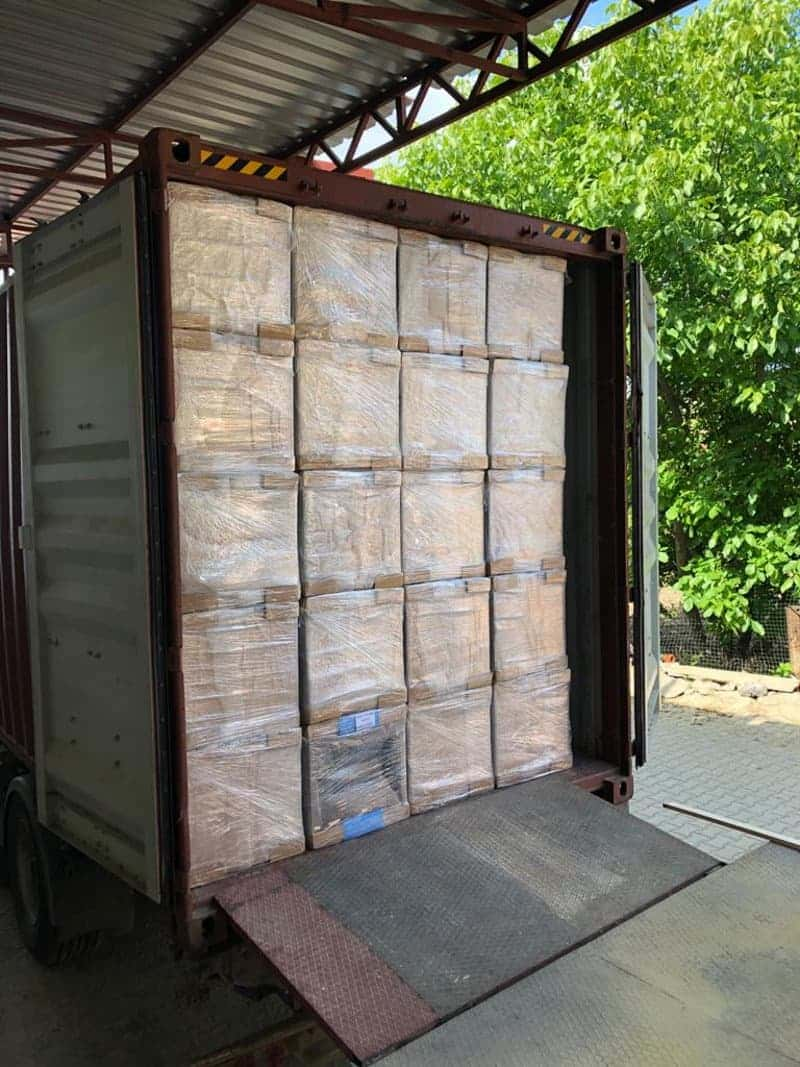
Ask who loads the container. A factory that loads its own containers controls how the goods are stacked and braced. A supplier who hands goods to a third party has less control over transit damage, and transit damage to edges is common.
Documentation is the other quiet risk. Export paperwork prepared in house moves faster than paperwork handed to an agent who never saw the goods.
We ship across Europe, Asia and Africa from Istanbul, and we prepare export documentation ourselves. If you want the specifics for your destination, our team can walk through it before you commit.
Execution insight
Work backwards from your first event, not forwards from your order date. Take the opening date, subtract installation and snagging, subtract customs clearance, subtract sea freight, then subtract production. Only then do you know your latest safe order date. Venues that plan forwards discover the gap two weeks before opening, and emergency hire for a single gala can cost more than the difference between a good table and a cheap one across the whole order.
Maintenance and realistic lifespan
Well-built banquet tables last a decade in a hotel and considerably less in a rental fleet. The gap comes almost entirely from handling rather than from the product itself.
Daily care of banquet tables is simple. Wipe with a damp cloth and a neutral cleaner, then dry. Avoid abrasive pads, which dull laminate and create a rough surface that then holds dirt. Avoid pooling water at the edge, which is how moisture finds the core.
Weekly, check the locks. A mechanism that needs a firm push today will need a kick in six months, and a kicked mechanism deforms. Tightening a loose lock takes a minute and prevents the failure that takes the table out of service.
Quarterly, check the feet. Worn caps are cheap to replace and expensive to ignore, because they scratch floors and they let the tube edge contact the surface directly.
Storage discipline protects banquet tables more than any cleaning routine. Banquet tables stored on a trolley, upright and braced, survive far longer than tables leaned against a wall where they slide, knock and take edge damage. Most of the damage we see in service photographs happened in the store room, not in the ballroom.
Expect eight to twelve years from banquet tables in a hotel ballroom with disciplined handling, five to eight in a high-rotation rental fleet, and far less anywhere tables get dragged rather than carried. The number reflects handling as much as product quality.
Track failures by cause rather than by count. Three tables lost to edge damage points at trolleys and doorways; three lost to lock failure points at the mechanism grade you bought.
Common specification mistakes to avoid
After enough projects, the same errors repeat when venues buy banquet tables. They are easy to avoid once you know to look for them.
The first is buying on top appearance alone. Two banquet tables with identical laminate can have completely different frames, and the frame decides the lifespan. Always ask what is underneath.
The second is ignoring the people who lift the banquet tables. A specification written in an office rarely accounts for a two-person banqueting team turning a room at midnight. Involve the operations team before you sign, because they will decide whether the tables get carried or dragged.
The third is under-ordering service banquet tables. Venues size for dining and then improvise for buffets, registration and back of house. That improvisation wears out the presentable tables first.
The fourth is treating banquet table trolleys as optional. We have covered this already, but it remains the most common false economy in the category.
The fifth is failing to record what you bought. Model codes, edge profiles and exact heights should live in a document that outlives the purchasing manager. Venues that lose this information cannot extend a set cleanly, and they end up replacing rather than adding.
Avoid those five and most of the risk in a banquet tables purchase disappears. What remains is a straightforward conversation about quantity, colour and delivery date.
None of these mistakes come from ignorance. They come from treating a ten-year purchase as a one-day transaction, and from letting the supplier set which questions get asked.
Where to go from here
Specifying banquet tables well comes down to three habits. Ask what is under the laminate. Ask what gauge the frame tube is. Write down exactly what you bought, so the next order matches.
Everything else follows from the event mix. Count your largest dining event, add service tables, add a small spare rate, and resist the urge to buy sizes you will not standardise on. Your linen budget will thank you every year afterwards.
We build these banquet tables ourselves in Istanbul, alongside the chairs, trolleys and staging that go with them, and we ship across Europe, Asia and Africa. If you want a second opinion on a specification you have already been quoted, send it over. Reading someone else’s quotation is often the fastest way to see what your own should say. You can also read the companion guide to banquet chairs and the rest of our banquet furniture guides.
One last suggestion. Before you sign anything, ask the supplier to send one sample table in the exact specification you intend to order. Put it in the store room, wheel it through a doorway, fold it twenty times and leave it under a chafing dish for an evening. A single week of real use tells you more than any brochure, and it costs almost nothing compared with replacing an entire set of banquet tables three years early.
Frequently asked questions about banquet tables
These are the questions buyers actually type into search, in roughly the order they ask them. If yours is not here, ask us directly and we will answer it against your room rather than in general terms.
What are banquet tables?
Banquet tables are commercial folding tables built for repeated setup in hotels, halls and event venues. They differ from domestic tables in frame gauge, top thickness and edge protection, because they get folded, wheeled and stored several times a week rather than standing in one place for years.
What size are banquet tables?
Round banquet tables run from 120 cm to 200 cm, or 48 to 79 inches. Rectangulars come mainly as 6 foot and 8 foot lengths at 76 cm depth. The 180 cm round and the 6 foot rectangular cover most venue requirements between them.
How long are banquet tables?
Rectangular banquet tables are usually 183 cm or 244 cm long, sold as 6 foot and 8 foot. A 6 foot table seats six to eight guests, an 8 foot table eight to ten. Longer runs get built by joining tables rather than by making a single longer top.
How wide are banquet tables?
Standard dining width is 76 cm, or 30 inches, which seats guests on both sides comfortably. Narrow banquet tables at 45 cm suit registration desks and buffet lines, where nobody sits. Choose 76 cm if guests eat at the table and 45 cm if the surface only carries equipment.
How tall are banquet tables?
Dining banquet tables stand at 76 cm, or 30 inches, matching standard chair seat height. Cocktail and poseur tables stand at roughly 110 cm for standing service. If a supplier quotes a dining height outside 74 to 78 cm, ask why before you accept it.
How much space should there be between banquet tables?
Allow around 150 cm, roughly 5 feet, between chair backs so two servers can pass. Squeeze that to 120 cm and service slows noticeably. Aisle width, not table count, usually decides how many banquet tables a ballroom can genuinely hold during a served dinner.
What are banquet tables made of?
Most commercial banquet tables use an 18 mm wood-based core faced with laminate, on a steel folding frame finished in electrostatic paint. Plastic blow-moulded tops exist for outdoor and school use. Edge treatment matters more than the core material, because banding fails before the top does.
How much do banquet tables cost?
Price depends on top thickness, frame gauge, edge treatment and order quantity rather than on shape. Frame steel alone accounts for roughly a third of the cost. When two quotations differ sharply, the saving almost always sits in a thinner tube wall or a cheaper glued edge band.
How long do banquet tables last?
Expect eight to twelve years in a hotel ballroom with disciplined handling, and five to eight in a high-rotation rental fleet. Lifespan depends more on how tables get stored and moved than on the product itself. Most damage we see in service happens in the store room.
What is the minimum order for banquet tables?
Our minimum is fifty pieces per model, and you can mix models within one order. Production takes four weeks from confirmation, including custom frame colours. Unit cost keeps improving above the minimum, because setup time for pressing and welding spreads across the run.