
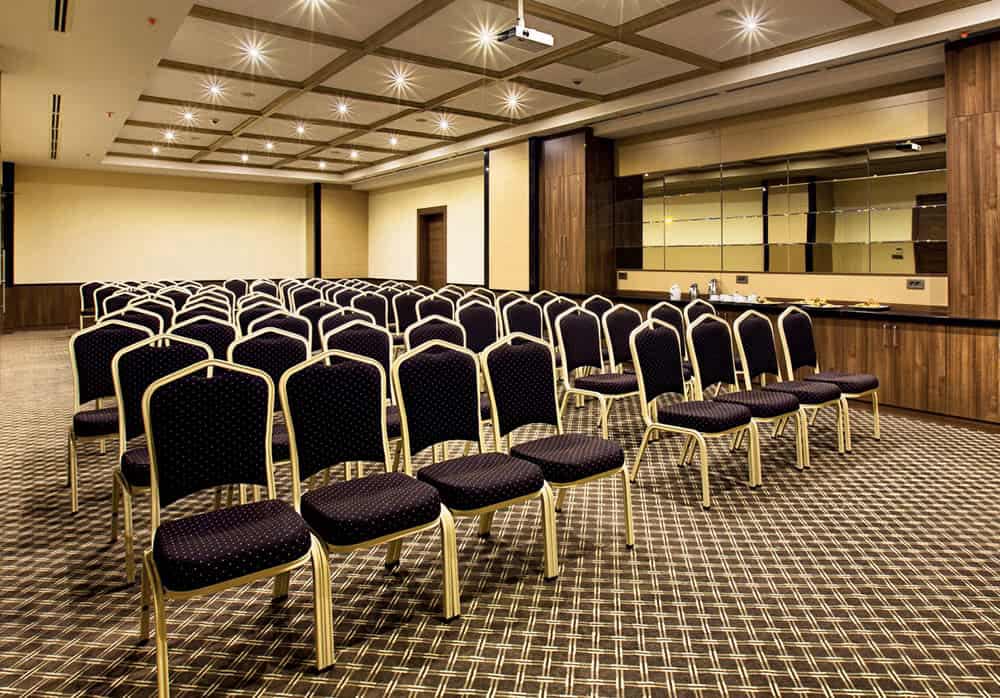
Most venues buy banquet chairs twice: once on price, and once properly, about six years later. The second order usually costs less over its life than the first one did. This guide exists to help you skip that first mistake. We build banquet chairs in Istanbul, and everything below comes from the questions buyers ask us on the factory floor, including the ones that argue against our own quotations. Read it alongside our guide to banquet tables, because chairs and tables decide each other more than most specifications admit.
Quick answer
Banquet chairs are stackable contract seats built for hotels, halls and conference venues. Most run an aluminium or steel frame, moulded foam and a fixed or flexible back. Judge them on tube gauge, foam density, stacking height and weld quality. Comfort across a three-hour dinner matters more than showroom appearance.
What banquet chairs are, and why venues replace them too soon
A banquet chair is contract seating designed to be stacked, wheeled, set and cleared many times a week. That sounds simple. The duty cycle is what makes it hard.
Think about what one chair actually endures. It holds an adult through a three-hour dinner. Then somebody stacks it eight high, wheels it across a car park and drops it into storage. Two days later the whole cycle repeats for a conference. Nothing in a domestic chair prepares for that.
Because the abuse is mechanical rather than cosmetic, banquet chairs fail in predictable places. Welds crack at the seat-to-leg junction. Foam flattens in the middle third. Stacking bumpers wear through and every chair starts scuffing the one below it.
None of this shows in year one. That is the whole problem. Cheap banquet chairs look identical to good ones on delivery day, and the difference only appears once the warranty has quietly expired.
So the useful question is not what a chair costs. It is what a chair costs per year of service. A set lasting twelve years at a higher price beats a set lasting five, and the arithmetic is rarely close. We treat banquet chairs as a decade-long commitment throughout this guide, because that is how they behave.
The types of banquet chairs you will be quoted
Suppliers build from a short list of families. Knowing the list makes quotations comparable, because you can push every vendor onto the same grid. Without it you compare an aluminium stacking frame against a wooden Chiavari and learn nothing.
One rule sorts most of it. Ask what the chair does when the room changes. A chair that stacks high and moves on a trolley suits a ballroom with many jobs. A decorative chair that stacks four high suits a room with one.
Weight is the second sorting tool, and the honest one. Pick up the sample. If a porter cannot carry two banquet chairs comfortably, your resets will slow down and your staff will find shortcuts that damage the furniture.
Price ranges overlap across families, which confuses buyers further. A good steel chair often costs more than a poor aluminium one. So the family name alone tells you very little about quality.
Check what the supplier actually manufactures. Many sellers list every family and build none of them. A factory that welds its own frames can change a seat height or a back profile for you. A trader can only change the photograph and the price.
Keep the shortlist short as well. Two or three models of banquet chairs, compared side by side in your own room, beats a catalogue of forty. Long lists flatter the supplier and exhaust the buyer, and chairs chosen by exhaustion rarely please anyone.
Finally, decide the family before you discuss colour. Construction narrows the field; fabric only decorates it. Buyers who reverse that order usually end up defending a decision they made for the wrong reason.
Stacking banquet chairs
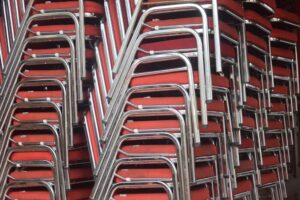
Stacking models dominate the market. They stack eight to twelve high, move on trolleys and let a ballroom turn over between a lunch and a gala. Most venues buying banquet chairs buy these.
Stacking height matters more than brochures suggest. A chair rated to stack ten high needs storage with real clearance. Ask for the stacked height in centimetres at your chosen count, then measure your door.
Look closely at the bumpers. Cheap banquet chairs use small plastic studs that wear through in a few seasons. After that, every stack marks the seat below it. Better designs use a moulded shoulder or a continuous glide that spreads the contact.
Check the stack for lean as well. Some frames nest tightly and still sway once a trolley moves. A swaying stack eventually goes over, and it usually takes the chair beside it. We cover the operational side in our note on how stackable banquet chairs save setup time.
Test the stack properly before you commit. Ask the supplier to stack ten banquet chairs and leave them for a week. Then look at the seat of the bottom chair. Marks after seven days mean marks after seven years.
Noise deserves a thought too. Metal frames ring when they separate, and a store next to a meeting room will hear every reset. Felt-faced bumpers cost almost nothing and solve it permanently.
Ask about the trolley at the same time. Some banquet chairs stack beautifully on the floor and sit badly on a dolly. The two need to be specified together, not bought a season apart.
Flexible-back banquet chairs
Flexible backs solve a specific problem. Guests sit for three hours at a wedding, and a rigid backrest becomes uncomfortable long before dessert. A back with controlled give relieves the lower spine without looking like an office chair.
The mechanism varies. Some designs flex the frame itself, others use a sprung mounting behind the upholstery. Both work when engineered properly. Both fail badly when a factory copies the look without the metallurgy.
Ask how many cycles the back is rated for. A flexing joint is a moving part, and moving parts have a life. If a supplier cannot answer, treat the chair as a fixed-back model that happens to wobble.
Flexible-back banquet chairs cost more per seat. They earn it in venues running long dinners, and they earn nothing at all in a conference room where people sit for forty minutes.
Watch the fabric at the flex point as well. A back that moves puts repeated stress on the upholstery seam behind it. Cheap stitching splits there long before the fabric itself wears out.
Consider a mixed order too. Flexible-back banquet chairs in the ballroom, where dinners run long, with simpler fixed backs in the meeting rooms. That split usually costs less than buying the premium chair everywhere.
One practical note on samples. Sit in a flexible back for the full length of a real dinner. Thirty seconds tells you nothing, and the difference between good and gimmicky only appears around hour two.
Ask what happens if the mechanism fails outside warranty. A flexing back is a moving part, so replacement components matter more here than on a rigid frame. Factories that build their own banquet chairs can supply them for years.
Chiavari and decorative event chairs
Chiavari chairs sell on appearance, and appearance genuinely matters in the wedding market. A room of gold or clear resin Chiavaris photographs in a way that a padded stacking chair never will.
The trade-offs are real. They stack low, usually four to six high. They damage easily at the leg, since the slender profile leaves little material. And they need cushion ties, which add a laundry cost nobody budgets for.
Many venues run a mixed inventory. A core of stacking banquet chairs for conferences and volume dining, plus a smaller run of Chiavaris for weddings. That split usually beats compromising on one chair for both jobs.
If you take that route, buy the decorative chairs in a colour that survives fashion. Gold and limewash age slowly. Strong colours date fast and cannot be repainted convincingly.
Budget for the cushions and the laundry from the start. Tie-on seat pads need washing, replacing and storing, and that recurring cost often exceeds the price difference against padded banquet chairs within a few years.
Storage is the other hidden cost. Decorative chairs stack low, so a hundred of them occupy far more floor than a hundred stacking banquet chairs. Measure the bay before you fall in love with the look.
If you do buy them, buy spares generously. Slender legs chip, and a chipped Chiavari cannot hide at the back of a wedding room. Five per cent extra is the usual working figure.
Think about who handles them, too. Decorative chairs bruise easily, and casual staff treat all banquet chairs the same way. If your porters work at speed, that alone may decide the format.
Conference and auditorium seating
Some rooms never change layout. Lecture halls, cinemas and fixed auditoria all need seating bolted to the floor or ganged in permanent rows, which puts them outside the banquet chairs category.
The difference is not just fixing. Auditorium seats use tip-up mechanisms, deeper foam and a much wider seat pitch. They also cost considerably more per seat, because the mechanism does most of the engineering work.
Venues sometimes ask whether banquet chairs can serve a lecture hall. They can, provided the rows link and the room does not need tip-up access. Beyond about two hundred fixed seats, purpose-built auditorium seating usually works out better.
Risk insight
Buying banquet chairs in batches years apart is the mistake we see most often, and the least recoverable. Foam suppliers change, fabric dye lots drift and frame tooling gets revised. Two runs of nominally identical banquet chairs, bought three years apart, will not match under ballroom lighting. Order your full projected count at once, or get written confirmation that the factory will hold your exact specification and dye lot for reorders.
Linking is the practical dividing line. If your local fire authority requires rows above a certain size to be joined, both fixed seating and loose banquet chairs need a linking solution, and the requirement should reach the specification early.
Sightlines matter more in these rooms than in a ballroom. Flat floors with deep rows lose the view within about eight rows. Either rake the floor, raise the platform or accept that the back third sees a screen and little else.
Ask about seat pitch too. Auditorium seats need more depth per row than banquet chairs do, so a room converted from dining to lecture use often loses fifteen per cent of its capacity.
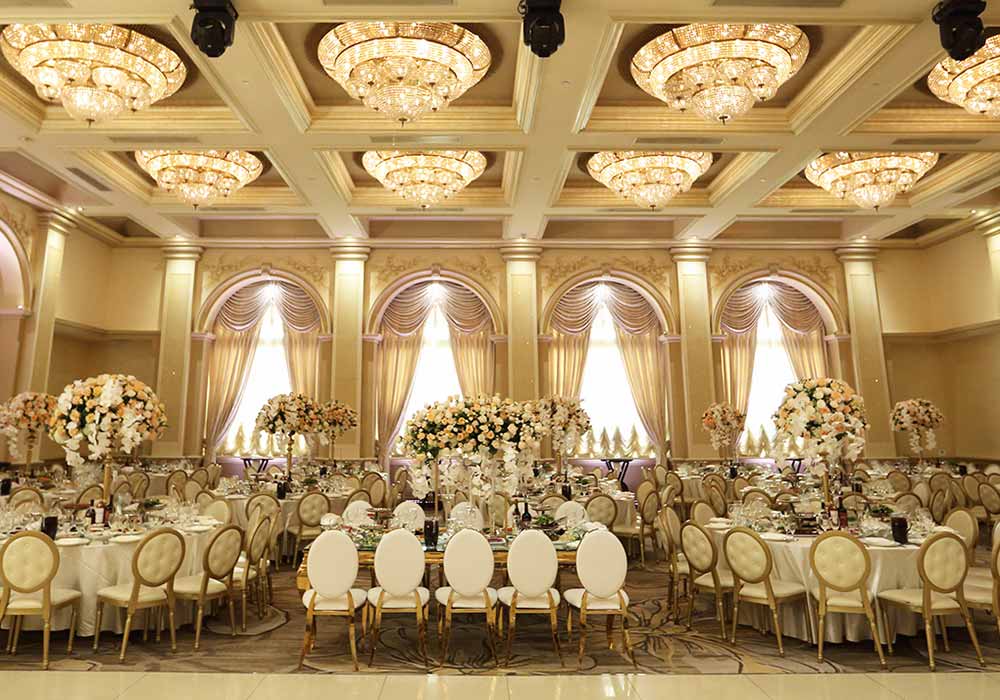
Frames: aluminium against steel
The frame decides how long banquet chairs last, and nothing else comes close. Foam can be replaced and fabric can be renewed. A cracked weld ends the chair.
Steel tube dominates because it is strong and cheap. What varies is wall thickness. A 1.5 mm wall behaves very differently from a 1.0 mm wall, and powder coat hides the difference completely. When two quotations sit far apart, tube gauge usually explains most of the gap.
Aluminium costs more per kilogram and saves real weight. That matters when porters stack three hundred chairs before breakfast. It also ignores humidity, so aluminium banquet chairs suit coastal hotels and unheated marquees where steel shows rust at the welds.
Welding quality separates manufacturers from assemblers. Ask for photographs of the weld before finishing, not after. A porous weld under a smooth black coat still fails in year eight, and by then nobody can prove why.
One quick test needs no tools. Grip the front rail and twist. A well-built frame resists and springs back. A thin one flexes and stays slightly out of true, which tells you exactly how it will age.
Ask for the tube gauge in writing on the quotation. Factories that build good banquet chairs state it without hesitation. Suppliers who avoid the question have already answered it.
Check the joint design as well as the weld. A leg that sockets into a seat frame and then gets welded holds far better than one butted against a flat face. The difference costs very little and shows up in year ten.
Finish matters mostly at the feet. Glides wear through, and bare tube on a stone floor scratches and rings. Specify replaceable glides on all your banquet chairs, then buy a spares box with the order.
Seat build: the part nobody inspects
Buyers look at fabric and frame. Almost nobody opens the seat, which is a shame, because the seat pan decides comfort and it decides when the chair starts to sag.
Foam density does most of the work. We specify moulded foam at 30 to 35 kilograms per cubic metre for banquet chairs. Below roughly 25, the foam takes a permanent set within two or three years and goes hard in the middle where everyone sits.
The base under the foam matters too. A plywood pan is cheap and stiff. Elastic webbing costs more and gives slightly, which feels better across a long dinner. Neither is wrong; they simply suit different budgets and different room types.
Seat depth belongs in the specification as well. Between 42 and 45 centimetres suits most adults. Shallower seats push weight onto the thighs. Deeper ones make guests slide forward and lose the backrest entirely.
Run the real test before ordering. Sit in a production sample for two hours while doing something else, then stand up and notice what aches. Three people should do this separately. It costs nothing and it prevents the most expensive kind of regret.
Mini data
Foam is roughly eight per cent of the cost of a banquet chair and causes most comfort complaints after year three. Moving from 25 kg/m³ to 33 kg/m³ adds a small amount per seat. Across four hundred banquet chairs that difference is real money. It is still far less than reupholstering the same set in year six, which runs several times higher per chair once labour is counted.
Upholstery and finish: what ages in public
Fabric is the part of banquet chairs that ages where guests can see it. Frames fail quietly. Upholstery fails visibly, at eye level, in the middle of a room you charge people to use.
Abrasion resistance is the number to demand, measured in Martindale cycles or double rubs. Contract banquet chairs should start at 40,000 Martindale. Anything under 30,000 belongs in a living room, whatever the swatch book says.
Cleanability comes next. Wine, sauce and children all land on these seats. Fabrics with a stain-release finish, or polyester content above roughly seventy per cent, take cleaning without going patchy.
Colour is where buyers spend the most time and the least thought. Two rules help. Mid-tones hide wear better than very dark or very light fabrics. And any colour that reads as current today will read as dated in eight years, which is well inside the life of a good chair.
Order spare fabric with the chairs. Ten to twenty metres, stored dry, lets you repair damaged banquet chairs from the original dye lot years later. Almost nobody does this. Almost everybody wishes they had.
Get large fabric samples, not small ones. A ten-centimetre square lies about how a fabric reads across four hundred seats. Ask for A4 pieces and view them in your own ballroom light, at the times of day you actually run events.
Then sit on one. Some fabrics look excellent and feel warm or slippery after an hour. Comfort in banquet chairs includes the surface, not only the foam under it.
Check the finish on the frame while you are at it. Textured powder coat hides handling marks far better than gloss, which shows every fingerprint under ballroom lighting.
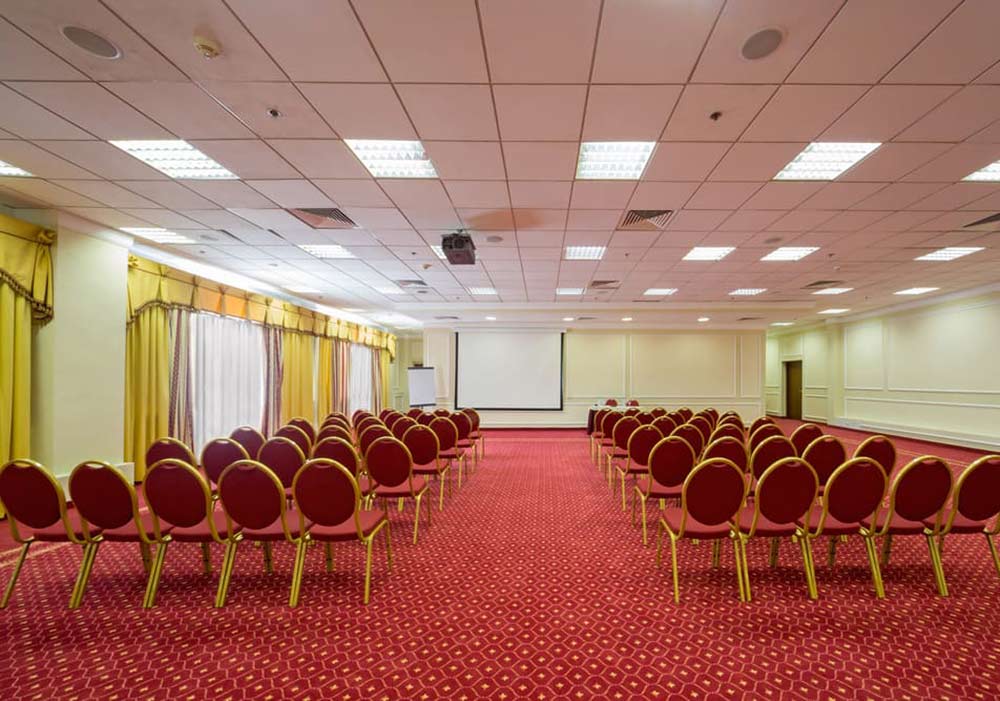
Stacking, trolleys and the storage arithmetic
Storage decides whether banquet chairs keep a room flexible. Venues that buy excellent chairs and no trolleys usually stop rearranging within a year, which defeats the reason they chose stacking chairs at all.
Start by measuring the storage bay, then work backwards. Chairs stacking ten high at roughly 150 centimetres need a door and a ceiling that clear a trolley carrying that stack, plus the porter pushing it.
Trolley design varies more than buyers expect. Single-column dollies handle uneven floors poorly and tip on thresholds. Twin-column trolleys carry more per trip and steer better, though they need more turning space at doorways.
Count the trips honestly. Four hundred banquet chairs at forty per trolley means ten trips out and ten back, before anyone straightens a row. Two trolleys roughly halve the elapsed time and remove most of the overtime.
Protect the stacks as well. Fitted covers keep dust off upholstery in a store that also holds staging and catering equipment. They cost very little and prevent the grey line that otherwise marks the top chair of every stack.
Execution insight
Buy trolleys with the chairs, not after the first complaint. Trolleys usually add under five per cent to an order of banquet chairs and change the labour cost of every turnaround afterwards. Moving a stack by hand needs two porters; a trolley needs one, and turns a two-hour ballroom reset into roughly forty minutes. Venues that defer trolleys nearly always buy them within eighteen months, having paid for the delay in overtime.
Agree your standard layouts and write them down. A floor plan taped inside the store door ends every argument about spacing during a late turnaround, and porters reset far faster when they are not guessing.
Matching banquet chairs to your tables
Chairs and tables get bought separately and used together. That gap causes more day-to-day frustration than any other specification error, and it is completely avoidable.
Start with heights. A standard banquet table sits at 75 centimetres. Banquet chairs should give roughly 28 to 30 centimetres of clearance between the seat and the underside of the table top. A seat height of 45 to 46 centimetres achieves that comfortably.
Then check the width. Ten guests around a 180 centimetre round need chairs no wider than about 45 centimetres at the seat, including any arms. Wider chairs simply mean nine covers instead of ten, and nine covers changes your revenue per event.
Watch the frame profile under the table apron too. A chair with a high back rail can foul the table edge, so it never pushes fully in. Guests then walk behind a row that projects further than the floor plan allowed.
Our banquet tables guide covers diameters, seat counts and the aisle arithmetic in detail. Read the two pages together before fixing either order, because changing one afterwards usually means changing both.
Test the fit before you order both, not after. Take a sample chair to a sample table and push it fully under. Then sit somebody in it and check the knee clearance with a normal place setting in front of them.
Arms deserve a decision of their own. They add comfort and they cost you covers, because armed banquet chairs need more width per guest. Most venues buy a small run with arms for top tables and none elsewhere.
Remember linen as well. A floor-length cloth on a round table narrows the space a chair can occupy, so a chair that fits bare may not fit dressed.
Weddings, conferences and the multi-use ballroom
The same room earns money in different ways, and each format asks something different from the furniture. Specifying for only one of them is how venues end up with two incompatible sets.
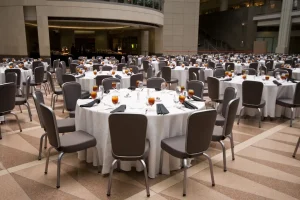
Weddings want appearance and comfort across three hours. Guests sit, eat, listen to speeches and stay put. Padded banquet chairs with a flexible back suit this format, and the photographs matter as much as the engineering.
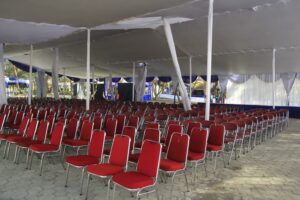
Conferences want fast resets and linking. Delegates sit for shorter stretches, but the room changes twice a day between theatre, cabaret and classroom. Light stacking chairs with a linking option earn their keep here.
Community and corporate dining sits between the two. It usually tolerates the conference chair, provided the foam is decent. Most venues therefore buy one good stacking chair as the core inventory, then add decorative chairs for the wedding market.
Storage capacity should follow the event mix, not the room size. Count how many chairs each format needs, take the largest, then add your spares. Buying beyond that stores money on a trolley.
Think about the changeover window too. A venue running a lunch and a gala on the same day has perhaps ninety minutes. That window, not the guest count, decides how many trolleys and how light your banquet chairs need to be.
Keep one format simple. Venues that promise every possible layout end up delivering none of them well, because staff cannot remember the plans.
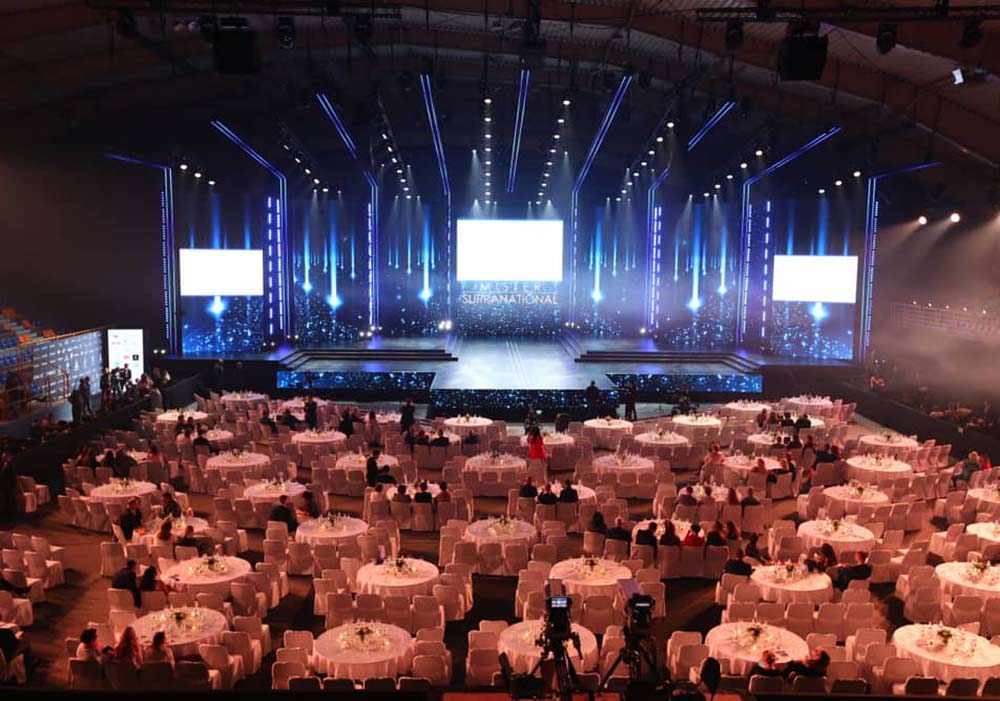
Standards, testing and what a real factory can show you
Standards separate banquet chairs that were engineered from banquet chairs that were merely assembled. Very few buyers ask about them, which is exactly why asking works so well as a filter.
In Europe, EN 16139 covers strength, durability and safety for non-domestic seating. In North America the conversation happens around BIFMA standards for general-purpose chairs. A genuine test report names the laboratory, the date and the exact model tested.
Ask for the report itself, not a summary. A supplier who sends a quality-system certificate such as ISO 9001 has answered a different question. ISO 9001 says the factory documents its processes. It says nothing about whether this chair survives 100,000 cycles.
Stacked load deserves its own question. A chair rated for a static seat load may still deform when eleven identical chairs rest on it in storage for a month. Ask specifically about stacked storage load, because that is how banquet chairs actually spend most of their life.
Finally, ask what happens when a part fails in year nine. A factory that welds its own frames can send you a replacement. A trader who bought one container from a factory that has since changed tooling cannot, whatever the warranty document promises.
Keep every certificate in one folder with the drawings and the order. Inspections happen years later, often under a different manager. A folder answers in ten minutes what an email search cannot answer at all.
Ask your insurer as well. Some policies for public assembly venues refer directly to seating and flammability standards. A short call before ordering costs nothing and occasionally changes the fabric specification.
European buyers can check the current status of seating standards through CEN, the European standards body, before accepting a supplier’s summary of them.
What banquet chairs cost, and where the money goes
Quotations for banquet chairs vary by a factor of three, and most of that spread is real rather than margin. Understanding the split makes a suspiciously cheap quote easy to read.
As a rough guide, the frame takes about a third of the cost. Foam and upholstery together take another third. The rest covers finishing, hardware, packing and freight. Accessories and linking sit on top of that.
The most common saving is tube gauge, because it is invisible forever. The second is foam density, invisible for about three years. The third is fabric grade, which announces itself around year five. None of the three appears in a photograph.
Send every supplier the same brief. State quantity, fabric grade, foam density, seat height and linking type. Then compare replies line by line instead of comparing totals, which is where cheap quotations hide.
Watch how they answer, not only what they charge. A factory that questions your foam choice is reading the brief. One that confirms everything instantly is selling, not advising.
Give suppliers a deadline for questions, then a deadline for the quote. Factories that ask nothing usually price a different chair from the one you described, and the gap only surfaces at delivery.
Ask for the price of the same banquet chairs at two quantities. The spread tells you how much of the quotation is setup and how much is materials, which is useful when you are deciding whether to add the meeting rooms now.
Finally, price the trolleys, spares and spare fabric as separate lines. Bundled quotations make it far too easy to cut the wrong thing later.
How many banquet chairs a venue actually needs
Buyers usually settle quantity last, after the specification. Doing it first would save real money, because volume changes what you can afford per seat.
Start from your largest realistic dining event rather than your record one. Take the guest count, then add ten per cent for damage, spares and the chairs that always seem to be somewhere else. That figure sets your core inventory.
Then handle the peak separately. A venue that hosts one eight-hundred-seat gala a year should not store two hundred extra banquet chairs for the other fifty-one weeks. Hiring for that single event almost always costs less than owning.
Count every room in the same order. Ballroom, meeting rooms, terrace and any overflow space should go into one purchase. Combining them lifts the volume, which improves the price per seat and guarantees the set matches.
Finally, order the spares now rather than later. Three to five per cent extra costs a fraction of a small reorder, and the colour will match. Small reorders are where matched sets quietly stop matching.
Ordering banquet chairs from Turkey
Most venues buying at volume now import, and Turkey sits usefully between European standards and competitive manufacturing cost. Here is how the process actually runs.
Samples come first. Ask for a production sample in your chosen fabric, not a polished showroom chair. We send samples on request, and we expect buyers to sit in them through a real dinner service before deciding. A supplier reluctant to send one has told you something.
Minimum order quantity for banquet chairs typically starts at fifty pieces. Below that, setup cost per chair climbs sharply and container freight stops making sense. Most venue projects clear the threshold easily.
Lead time runs around four weeks in production for a standard specification, plus shipping. Sea freight adds one to two weeks to northern Europe and four to six to North America. Work backwards from your opening date, never forwards from your order date.
Payment normally splits fifty per cent on order and fifty on completion, before shipment. Agree the inspection point in writing. Our sourcing notes on buying banquet chairs from Turkey cover documentation, and you can send a specification through the quote form.
Confirm the labelling before shipment. Cartons marked with model, fabric and quantity let porters put the right banquet chairs in the right store on arrival. Unmarked cartons get opened in the ballroom, which wastes an hour and a clean floor.
Agree the inspection point in writing as well. Photographs of the finished run, or a third-party check before loading, protect both sides and cost far less than a dispute after arrival.
Ask about spare parts in the same conversation. Glides, bumpers and linking clips weigh almost nothing and travel free inside the container.
Shipping, container loading and lead time
Furniture that arrives late is not furniture; it is a problem with a delivery note. For imported banquet chairs, logistics deserve as much attention as the specification does.
Stacking chairs load densely, which is the quiet financial advantage of the format. A forty-foot container carries a large number of stacked banquet chairs, so the freight cost per seat stays modest even on long routes.
Packing method decides how they arrive. Chairs travel stacked, and stacked chairs rub. Corner protection plus a fitted cover on each stack prevents almost all transit marking, and it costs very little compared with touching up two hundred frames.
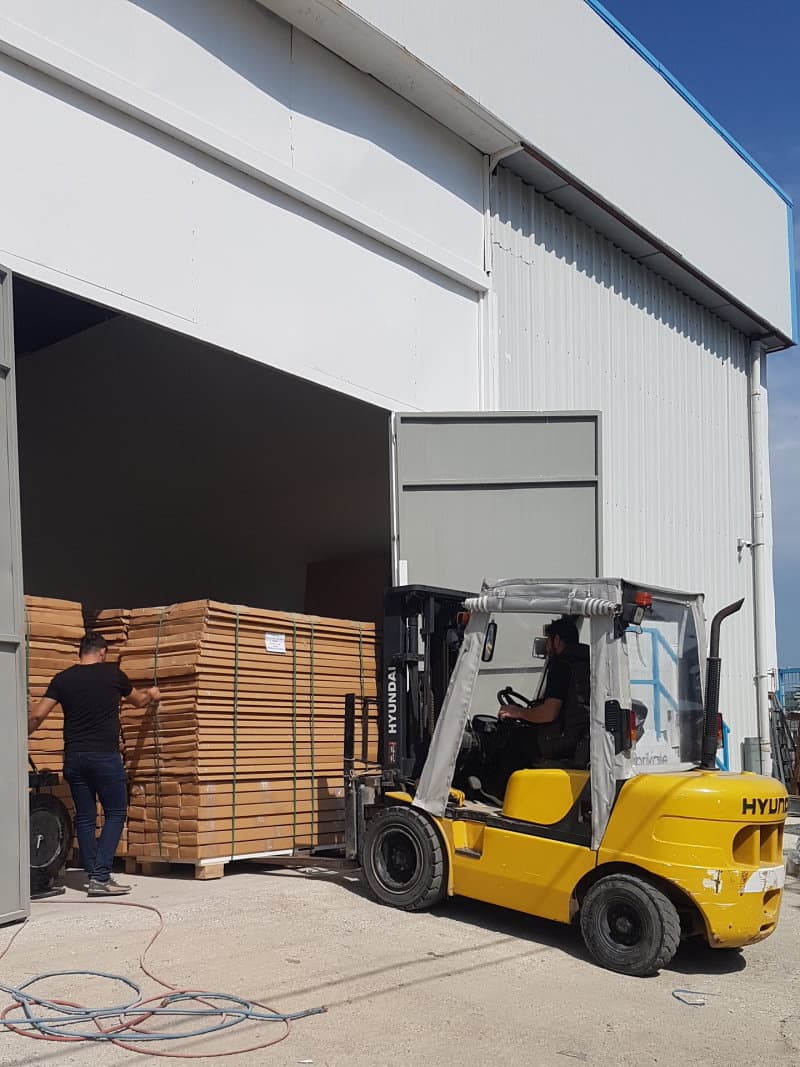
Plan the unloading before the lorry arrives. A container of banquet chairs comes with a driver on a schedule. Three porters and two trolleys turn that into an hour. Two people without a trolley turn it into an afternoon and a damaged first stack.
Photograph the delivery. Dated photographs settle any later question about transit damage, and they make an insurance claim straightforward rather than a negotiation.
Book the delivery window with the operations team, not only with the freight forwarder. A container arriving during a live event costs far more in disruption than the demurrage you were avoiding.
Count the delivery against the packing list before the driver leaves. Shortages found the same day get resolved quickly. Shortages found three weeks later become a long email chain and, usually, your problem.
Store the first stack of banquet chairs where you can reach it easily. That stack becomes your reference set for colour and condition when you reorder or make a claim.
Maintenance and realistic lifespan
Well-specified banquet chairs last twelve to twenty years. Neglected ones reach six. The difference costs almost nothing and takes about an hour a quarter.
Check glides and bumpers quarterly. Both are consumables and both cause damage when ignored. A worn glide scratches floors. A worn bumper marks every chair underneath it in the stack.
Vacuum the upholstery rather than waiting for visible dirt. Grit in fabric works as an abrasive every time somebody sits down, which is why the seat front always wears first in dusty venues.
Rotate the inventory annually. Chairs stored at the front of the bay get used far more than the ones at the back. Rotating evens out the wear and can add several years before the set starts to look tired.
We go deeper into wear patterns and replacement timing in our article on how long banquet chairs last. Keep a small parts box on site as well, since most repairs need a glide, a bumper or a screw.
Write the checks into the operations diary rather than trusting memory. Four short inspections a year, twenty minutes each, catch nearly every fault while it is still cheap to fix.
Log repairs in one place too. Over a decade that log shows which banquet chairs take the worst use and whether a batch shares a fault. It also makes the case for the next order far easier to argue with a finance director.
Train the porters once, properly. Most damage to banquet chairs happens during stacking, and ten minutes of instruction prevents years of chipped frames.
Common specification mistakes to avoid
After enough projects the same errors repeat. None are foolish. Each comes from optimising the wrong thing at the wrong moment.
The first is choosing fabric before construction. Colour is the easiest thing to debate and the least important thing to get right, yet it routinely takes three meetings while tube gauge takes none.
The second is buying for the biggest possible event. That inflates the order, drains the budget that should have raised quality and leaves you storing banquet chairs you use twice a year.
The third is skipping the sitting test. A chair that feels fine for thirty seconds tells you nothing about hour three. Buyers who sit properly in a sample almost never regret the chair they picked.
The fourth is cutting trolleys, spares and spare fabric when the quote comes back high. They are the cheapest insurance in the project. Cutting them is how a fifteen-year set becomes an eight-year one.
Keep a small parts box on site as well. Glides, bumpers and a handful of screws cover most repairs, and a chair sitting broken in a store for six months usually needed a component worth very little.
Clean spills within the hour. Most contract fabrics release stains easily while fresh and reluctantly after a week. Blot rather than rub, and use water with a mild detergent instead of solvent.
Finally, review the whole inventory once a year. Twenty minutes with a clipboard tells you how many banquet chairs are genuinely serviceable, which is usually a smaller number than the purchase order suggests.
Where to go from here
The decision comes down to three numbers and two hours. The numbers are tube gauge, foam density and abrasion rating. The hours are the sitting test with a real production sample. Get those right and the rest tends to follow.
Start by measuring your storage bay and counting your largest realistic event. Those two figures constrain the chair more than any aesthetic preference, and knowing them turns a vague supplier conversation into a specific one.
Then read the tables guide alongside this page, since seat height, seat width and table diameter decide each other. Once you have a layout and a quantity, request production samples from two or three factories and sit in all of them.
You can browse current models in our metal banquet chairs and aluminium banquet chairs ranges, or read the rest of our banquet furniture guides for tables, stacking and durability. When you are ready for numbers, send your room dimensions and event mix through the quote form.
One last thought. The chair you buy today gets sat in by roughly forty thousand guests before you replace it. Specify for guest number forty thousand, not for the boardroom presentation next week.
Frequently asked questions about banquet chairs
The fifth mistake is ordering before measuring the storage bay. It sounds obvious. Yet venues regularly discover on delivery day that a full stack will not pass through the store door on a trolley.
These are the questions buyers ask us most often. The answers assume banquet chairs bought in quantity for a hotel or hall rather than a handful for an office.
How much do banquet chairs cost?
Banquet chairs vary widely by construction. A thin-gauge frame with low-density foam sits at the bottom of the market, while a 1.5 mm frame with 33 kg/m³ foam and 40,000-Martindale fabric costs considerably more. Compare cost per seat per year instead of headline price, since lifespan varies more than price does.
How high do banquet chairs stack?
Most stacking banquet chairs stack between eight and twelve high, depending on frame geometry and whether the back is flexible. Ask for the stacked height in centimetres at your chosen count rather than the count alone, then check it against your store door, ceiling and trolley before ordering.
What seat height should banquet chairs have?
Specify 45 to 46 centimetres for use with standard 75 centimetre banquet tables. That gives roughly 28 to 30 centimetres of thigh clearance, which most adults find comfortable through a long dinner. Lower seats feel cramped under the table apron and higher ones leave guests perched.
How many banquet chairs fit around a round table?
A 180 centimetre round seats ten banquet chairs comfortably at up to 45 centimetres seat width. A 152 centimetre round seats eight. Wider chairs, or chairs with arms, reduce each count by one, which changes covers per event and therefore revenue.
Are aluminium banquet chairs better than steel?
Aluminium banquet chairs weigh less and ignore humidity, so they suit coastal hotels, marquees and venues with frequent resets. Steel costs less and takes impact better. Neither wins outright. Choose aluminium when staff move chairs daily, and steel when the set stays largely in place.
How long do banquet chairs last?
Well-specified banquet chairs last twelve to twenty years with quarterly checks and annual rotation. Thin frames with low-density foam typically reach six to eight. The frame sets the ceiling, while foam and fabric decide when the set starts looking tired. Both can be renewed if the frame survives.
What is the minimum order for banquet chairs from a factory?
Minimum order quantity usually starts around fifty pieces for banquet chairs. Below that, setup cost per chair rises sharply and container freight stops making economic sense. Most venue projects clear the threshold, particularly when meeting rooms and overflow spaces join the same order.
Can banquet chairs be reupholstered instead of replaced?
Yes, provided the frame stays sound and the factory still supplies parts. Reupholstering costs a fraction of replacement and extends a good set by another decade. Order ten to twenty spare metres of fabric with the chairs so later repairs match the original dye lot.