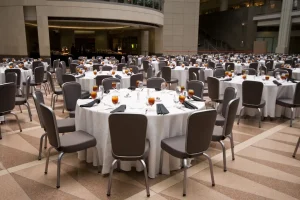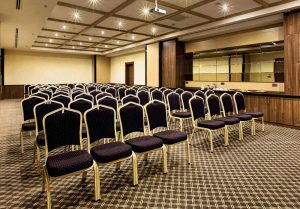

Stackable banquet chairs exist for one reason: rooms have to change. A ballroom that seats four hundred for dinner must seat six hundred in theatre style the next morning, and every chair has to disappear in between. This guide covers how stackable banquet chairs actually perform once they leave the brochure, and what the numbers mean for your storeroom, your staff and your schedule.
We manufacture in Istanbul, so the figures below come from our own frames rather than from a catalogue. If you are still deciding between chair types altogether, read our banquet chairs buyer’s guide first, then come back for the stacking detail.
What makes a chair a stackable banquet chair
Stacking is a design decision, not a feature bolted on afterwards. Three things have to be true.
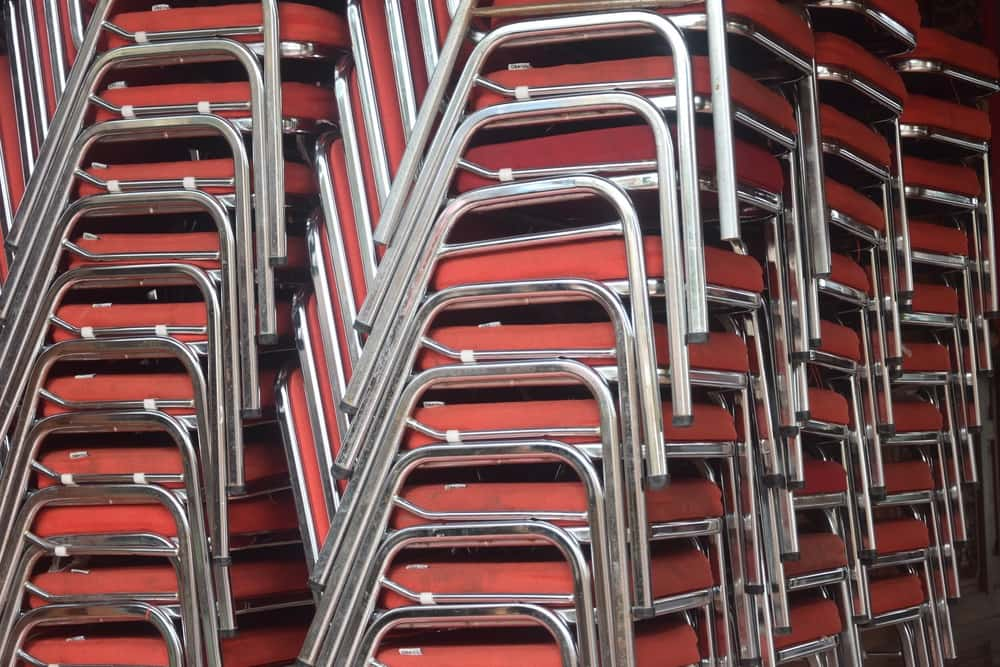
First, the frame has to nest. The legs taper slightly inwards so the chair above drops into the one below rather than sitting on top of it. Second, the seat and back have to clear each other. Third, the frame needs contact points that touch the chair beneath in the same place every time.
When those three conditions hold, a stack behaves like one object. When they do not, the stack leans, and a leaning stack is the single most common cause of damage in a banquet store.
Our aluminium and steel ranges share the same geometry, so they nest identically. That matters more than it sounds. Venues that buy in phases can add chairs three years later and still stack them together.
How high do stackable banquet chairs really stack?
Our chairs stack twelve high. Most competitors quote between eight and twelve, and the number is easy to check because it is geometry rather than marketing.
However, twelve is a maximum, not a working figure. Here is the practical rule: stack to the height your shortest staff member can reach safely, then stop. In most venues that means ten.
The reason is simple. The top chair of a twelve-high stack sits around two metres up. Lifting a 5.4 kg chair above shoulder height is awkward, and awkward lifting is how chairs get dropped. Consequently the last two chairs in a stack often cost more in damage than they save in floor space.
There is a second limit that catalogues rarely mention. A tall stack has a narrow base, so it tips easily when pushed. If your team moves stacks by hand rather than on trolleys, treat eight as your ceiling.
The weight arithmetic nobody does before buying
Weight decides how a stack gets handled, and handling decides how long the chairs survive. So the arithmetic is worth two minutes.
An aluminium banquet chair on a 25×25×2 mm frame weighs about 5.4 kg. Twelve of them make a stack of roughly 65 kg. A steel chair on a 25×25×1.2 mm frame weighs about 7.5 kg, so the same stack reaches 90 kg.
Neither figure is liftable, and neither is meant to be. Both are meant to roll. Nevertheless staff will push a 65 kg stack across a carpet without thinking, whereas they hesitate at 90 kg and go looking for the trolley. That hesitation is worth money.
Scale it up and the difference becomes obvious. Four hundred aluminium chairs weigh 2,160 kg in total; the same number in steel weigh 3,000 kg. Over a year of resets, that is 840 kg of extra lifting for every full turnaround of the room.
Trolleys are what make stackable banquet chairs work
A stacking chair without a trolley is only half a system. Venues that skip the trolley spend the saving twice over on repairs.
A chair trolley takes a stack of ten to twelve, rolls on non-marking castors, and turns a two-person lift into a one-person push. Therefore the labour saving is immediate: one member of staff can clear a hundred chairs in the time two would clear forty.
Trolleys also protect floors. Dragged stacks scratch parquet and tear carpet, and floor repairs cost far more than the chairs did. Our range includes trolleys designed for these frames, listed under ancillary products.
Buy one trolley for every forty to fifty chairs. That ratio keeps a full room clearing in a single pass, and it leaves spare capacity when part of the inventory is out for cleaning.
How much storage space stackable banquet chairs need
This is the calculation that decides whether a room works, and most venues get it wrong by a factor of two.
A stack of twelve occupies roughly 0.55 m by 0.55 m on the floor. So four hundred chairs make thirty-four stacks, which need about ten square metres of pure footprint. However, footprint is not the same as storeroom size.
Add access. You need a hand’s width between stacks so foam is not crushed, and you need an aisle wide enough for a loaded trolley to turn. In practice, plan on double the footprint. Four hundred chairs therefore want twenty square metres of store, not ten.
Height matters as well. A twelve-high stack stands around two metres tall, so a store with a 2.2 metre ceiling and a low door frame will force you down to eight or nine per stack. Measure the door before you measure the room.
Finally, keep the tables in the same calculation. Chairs and tables compete for the same store, and folded tables are far less forgiving about access. Our banquet tables guide covers those dimensions.
Aluminium or steel: which stacks better?
Both stack twelve high in our range, so the question is really about handling and environment.
Aluminium wins where chairs move often. It is 2 kg lighter per chair, it does not rust in a damp basement store, and staff handle it more willingly. Venues that reset three or four times a week almost always end up with aluminium after they have tried both.
Steel wins where chairs stay put. It costs less per unit, it is stiffer under load, and in a dry store the rust risk never materialises. For a conference centre that sets a layout and leaves it, steel is the better economics.
The frames are otherwise identical, which means the decision is reversible in phases. You can browse both in aluminium banquet chairs and metal banquet chairs.
Protecting the finish inside a stack
Every stacking cycle puts metal against metal. Without protection, that contact removes paint, and bare metal at a contact point is where rust starts.
All of our frames carry anti-scratch rubber at the stacking contact points. It is a small detail that decides whether a five-year-old stack still looks new when it is set out.
Fabric needs protecting too. When one seat rests against the back of the chair below, grit between them acts like sandpaper. Consequently a quick wipe of the seat tops before storage does more for appearance than any cleaning schedule afterwards.
Ask any supplier where the rubber sits and what happens when it wears. If the answer is vague, the chairs will mark each other within two seasons.
How stacking saves labour, in real numbers
Managers buy stackable banquet chairs to save time, so it helps to know what the saving looks like.
Clearing a chair by hand, one at a time, takes roughly fifteen seconds per chair including the walk. Four hundred chairs therefore take about one hundred minutes for a single member of staff.
With stacking and trolleys, the same job runs at roughly five seconds per chair. That is thirty-three minutes. Over a venue that turns a room two hundred times a year, the difference is more than two hundred hours of labour.
There is a second saving that rarely appears in the business case. Faster turnarounds let you sell the room twice in a day. One extra booking a month usually pays for the trolleys within a year.
Fatigue matters as well. Staff who are not exhausted at midnight handle chairs more carefully, which feeds directly into lifespan. We cover that link in our guide to how long banquet chairs last.
Stackable against folding chairs
Folding chairs store flatter, so the comparison seems obvious until you run it properly.
A folding chair is thinner in the stack, yet it needs a mechanism, and mechanisms wear. Hinges loosen, latches seize, and a folding chair typically lasts around half as long as a stacking one in the same room.
Setting is slower too. Every folding chair has to be opened individually, which adds a second or two per chair. Across four hundred chairs that erases much of the storage advantage.
Comfort is the third difference. A folding frame cannot carry 80 mm of foam over a rigid support, so guests feel the difference within an hour. For dinners and conferences, that alone decides it.
Most venues therefore keep folding chairs as overflow and buy stackable banquet chairs for the core inventory.
Mistakes buyers make when specifying stackable banquet chairs
These are the five we see most often, and all of them are avoidable at order time.
The first is buying the stacking height without buying the trolleys. The chairs then get dragged, and the saving disappears into repairs.
The second is ignoring door and ceiling heights. A stack that cannot leave the store is not a stack; it is an obstruction.
The third is mixing models. Chairs from different suppliers rarely nest, so a phased purchase from two sources produces two separate inventories that cannot share a trolley.
The fourth is under-ordering spares. Order about five per cent above capacity so damaged chairs can leave service without breaking the set.
The fifth is forgetting linking hardware. Conference and worship layouts often need chairs joined in rows, and retrofitting linkers later costs more than specifying them now. Our church chairs guide explains where linking matters most.
Comfort in a stacking frame
Stacking imposes a shape, and a lot of chairs sacrifice comfort to achieve it. They do not have to.
The constraint is depth. A seat that nests has to keep its front edge clear of the chair below, so the cushion cannot be thick everywhere. The answer is a rigid support with dense foam on top rather than soft foam alone.
We build seats on 80 mm of W55-density polyurethane foam over an 11 mm OSB board, with a 30 mm pad on the backrest. That combination holds its shape through a three-hour dinner, and it still nests correctly in the stack.
Guests notice this in the second hour, not the first. Any chair feels acceptable for twenty minutes, so test a sample by sitting in it through a whole meeting before you order four hundred.
Backrest angle matters too. A back that leans too far cannot stack tightly, whereas one that is bolt upright pushes guests forward. Most contract designs settle around a modest recline, and that compromise is why stackable banquet chairs across the market look broadly similar.
Colour, fabric and keeping a room consistent
A stack is also a colour decision, because you will be matching it for years.
Frame colour comes from an electrostatic process, so any RAL shade is available. Nevertheless, stick to standard shades if you expect to expand the inventory later. Unusual colours are easy to order once and hard to match in year four.
Fabric is the same story. Contract fabrics are woven in batches, and batches drift. Order slightly more than you need and keep the surplus, because a repaired chair in a near-miss colour is more visible than a worn one.
Consider how the fabric behaves in a stack as well. Deep piles and loose weaves catch on the frame above, whereas a tight contract weave slides cleanly. That single property affects how quickly staff can work.
How many stackable banquet chairs a venue needs
Buy for your largest layout, not your average one. Then add spares.
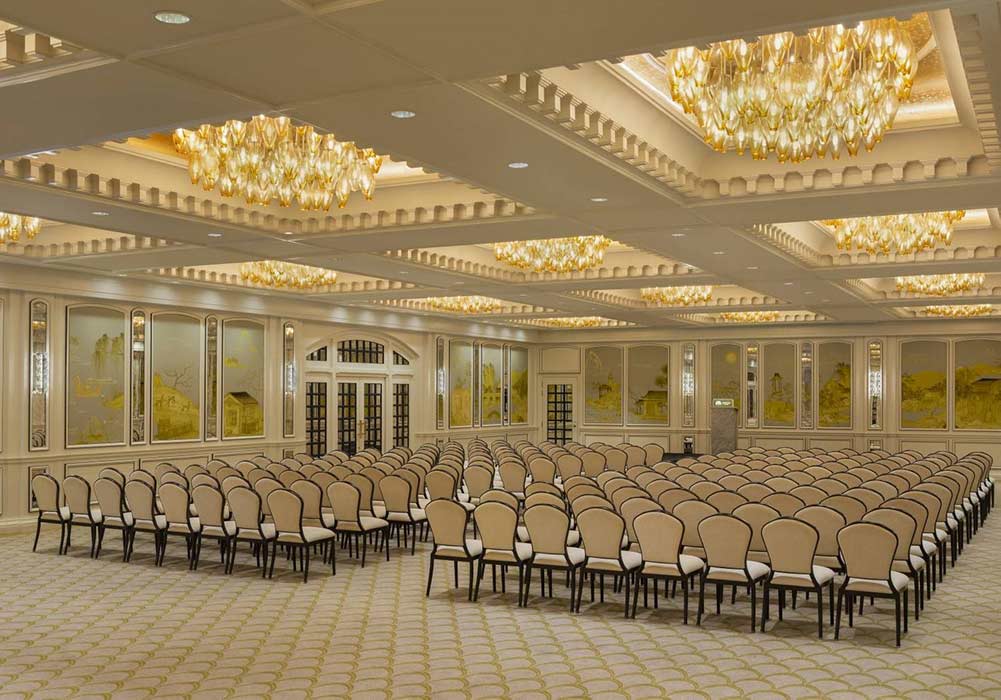
Start by counting the theatre-style capacity of your biggest room, since theatre packs more chairs into a space than any other format. That number is your baseline.
Next, check whether two rooms are ever used at once. If they are, the baseline has to cover both, because chairs cannot be in two places on the same evening.
Then add five per cent for damage and cleaning. A venue with a 400-seat baseline should therefore hold about 420 chairs. That margin lets you take chairs out of service without renting replacements at short notice.
Finally, remember that stacking capacity has to grow with the inventory. Twenty extra chairs need two more stacks and a corner to put them in.
Stacking outdoors and in marquees
Outdoor events change the rules, and they change them quickly.
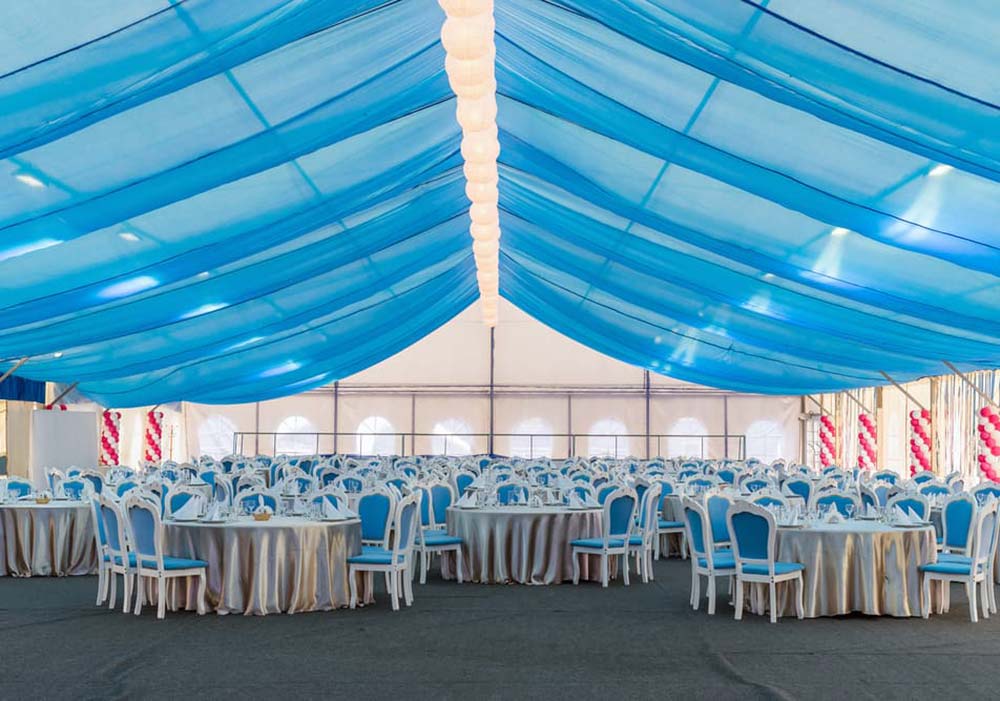
Grass is uneven, so a stack that is stable indoors can tip on a lawn. Keep outdoor stacks to six and move them on a trolley with larger wheels.
Moisture is the bigger risk. A stack left out overnight traps damp between seats, and foam holds that water for days. Therefore bring chairs in before dew forms, even when the forecast is dry.
Aluminium frames handle this far better than steel, because a chipped steel frame starts rusting the first time it stays wet. Venues that set outside regularly usually standardise on aluminium for that reason alone.
Buying stackable banquet chairs from the factory
Where you buy changes what you can do in year five, which is why it belongs in this guide.
A manufacturer holds the tooling, the foam specification and the fabric references. Consequently matching parts stay available, and a repair in year six looks like the original chair. Resellers change suppliers, and the match disappears.
Direct orders also let you specify rather than choose. Frame colour, fabric, linking hardware, trolley quantities and even carton labelling can be set at order time instead of accepted as standard.
Ask for the four numbers that matter before you compare prices: frame tube size, foam density and thickness, fabric abrasion rating, and rated stacking height. Any real factory answers all four in a sentence.
Where to go from here
Measure your store and your doors before you choose a stacking height. Then buy trolleys in the same order as the chairs, because the two only work together.
When you are ready to compare specifications, send your room sizes and quantities through our quote form and we will come back with a stacking and storage plan rather than only a price.
Frequently asked questions
How many stackable banquet chairs fit on one trolley?
Ten to twelve on our standard trolley, depending on the model. Plan one trolley for every forty to fifty chairs in the inventory.
Do stackable banquet chairs damage each other in storage?
Not when rubber protection is fitted at the contact points and stacks stay within the rated height. Damage comes from over-tall stacks and from dragging.
How much floor space do four hundred chairs need?
About ten square metres as pure footprint, and roughly twenty once you add access aisles and spacing between stacks.
Are aluminium stackable banquet chairs strong enough for daily use?
Yes. A 25×25×2 mm aluminium frame is built for contract use, and it avoids the rust risk that shortens steel frames in damp stores.
Can stackable chairs be linked together in rows?
Most models accept linking hardware. Specify it with the order, because retrofitting is far more expensive.