

Church pews versus chairs is the decision congregations argue about longest and research least. It gets framed as tradition against modernity, when in practice it is a question about the room: whether the floor needs to do one job well or several jobs adequately. We manufacture church seating in Istanbul and supply both kinds of building, so the comparison below is drawn from installations rather than from catalogue copy.
If you have already settled the question and are choosing the seating itself, our complete church chairs buying guide covers frames, foam and linking. If you are working on the arrangement, the six church seating layouts guide sets the options side by side.
The decision is about the room, not the furniture
Pews fix a room to one use. That is not a criticism; a sanctuary that only ever holds services loses nothing by being fixed, and gains a coherence that loose seating rarely matches.
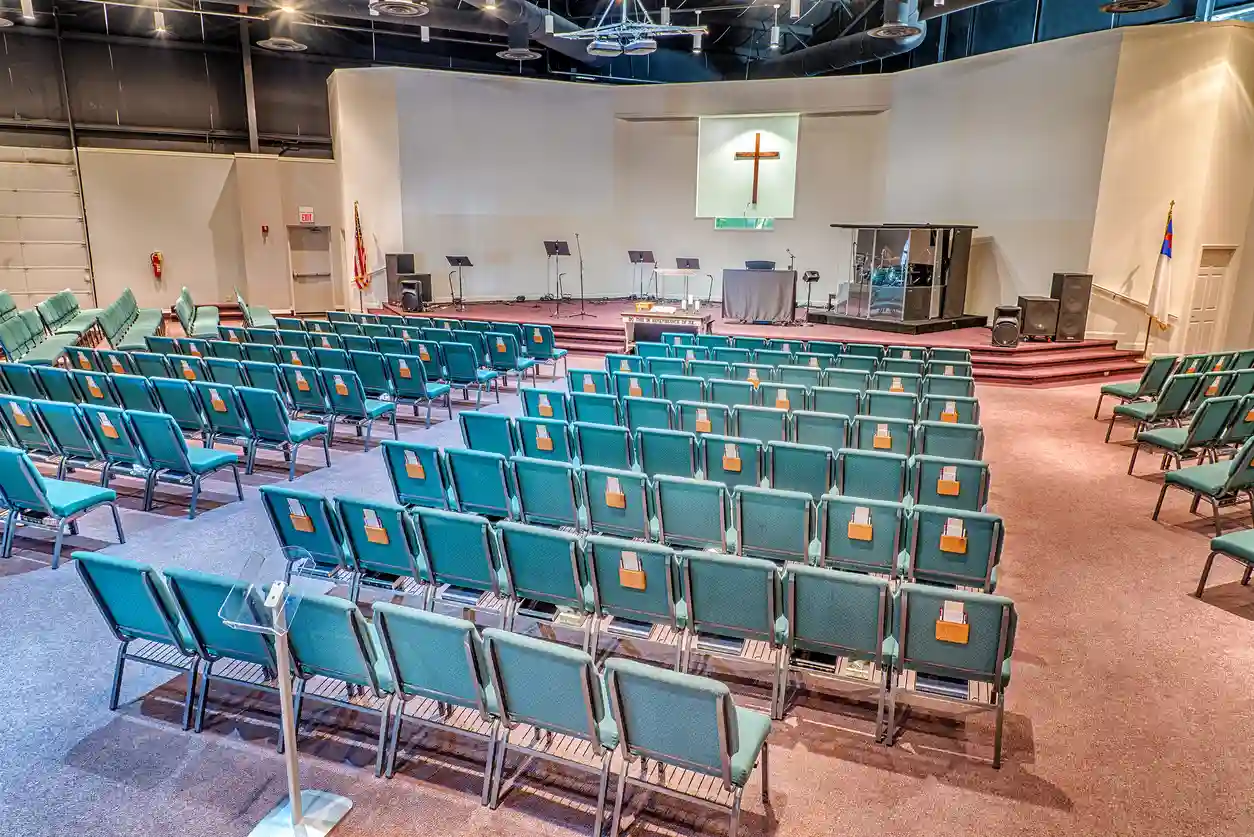
Chairs make the floor available. The same hall takes a service on Sunday morning, a funeral reception on Tuesday, a toddler group on Wednesday and a concert on Friday. Every one of those uses needs the chairs somewhere else, or nowhere at all.
So the honest first question is not which is better. It is how many different things the room has to do in a normal month. Congregations that answer “one” should look hard at pews. Congregations that answer “four” have usually already decided, whether they know it or not.
Capacity: which actually seats more people
Pews look like they seat more, because there are no arms and no gaps. In use they frequently seat fewer, and the reason is human rather than dimensional.
Our working figure is 500 to 550 mm of width per person. On a pew nothing enforces that. People sit where they like, leave a polite gap, and a bench measured for twelve holds nine. Congregations self-limit, and the capacity you paid for never appears. Chairs enforce the spacing because each seat is a discrete object; fourteen chairs in a row is fourteen people.
The other half of the arithmetic is row depth. We set 850 to 900 mm from seat front to seat front, which leaves roughly 300 mm of clear passage. Pews are commonly installed tighter than that because the joinery is fixed and nobody wants to lose a row. At 800 mm people have to stand to let others past, and the middle of the row stops being used at all.
Aisles behave the same way. Keep the main aisle at 1,200 mm minimum, or 1,500 mm above 250 seats, and side aisles at 1,000 mm. With chairs you can move an aisle by 200 mm on a Saturday morning. With pews you cannot move it at all.
Net result across the buildings we have supplied: for the same floor area, chairs usually deliver more usable seats than pews, not fewer. The exception is a long narrow nave with a single central aisle, where a continuous bench genuinely does use the width better.
Cost over twenty years, not on the invoice
Pews are joinery. They are made to the building, they carry a cabinetmaker’s hours, and they are priced per linear metre of bench rather than per seat. Chairs are manufactured in runs and priced per unit.
That difference matters less on day one than it does across the life of the room. Three things move the twenty-year number.
Phasing. A chair order can be split. Buy 200 now and 100 next year when the balance recovers. A pew installation cannot sensibly be half-finished.
Repair. When a chair fails you replace that chair. When a pew fails you repair joinery in place, in a building that is in use, usually by a specialist.
Reconfiguration. Every change to a pew layout is a building project. Every change to a chair layout is a Saturday morning and a trolley.
What we would not claim is that chairs are always cheaper on the invoice. A high-specification church chair in good fabric is not a cheap object, and a simple pew in local softwood can undercut it. The saving shows up later, and only if the room actually changes.
Comfort across a ninety-minute service
This is where the received wisdom is wrong in both directions.
Pews are not inherently uncomfortable. A well-made pew with a shaped back and a cushion is comfortable for an hour. A flat plywood bench is not, and most of the pews people remember unfondly are the second kind.
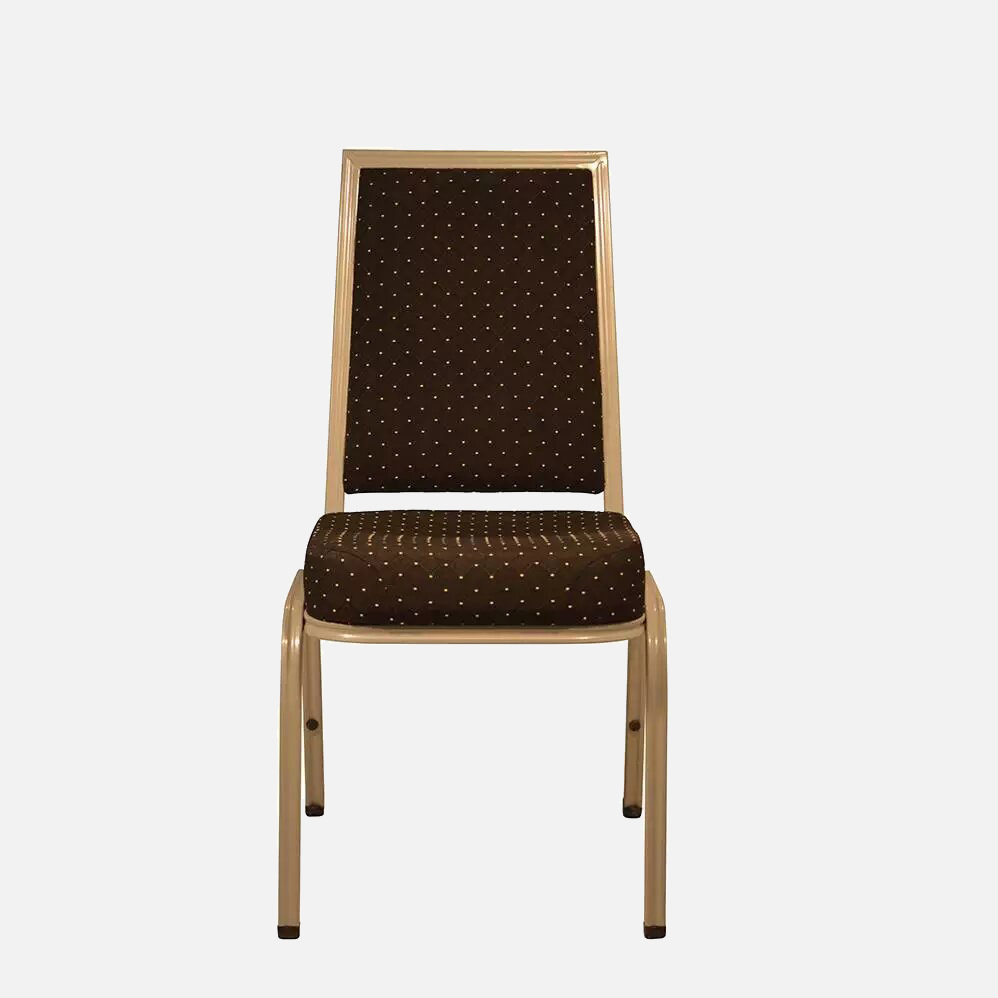
Chairs are not inherently comfortable either. A church chair with 30 mm of foam over a hard board is worse than a decent pew. What we build for worship spaces uses an 80 mm seat foam over an OSB base, which is the same seat construction as our banquet range, because the sitting time is comparable.
The real comfort difference is postural. A pew holds a fixed relationship between seat and back for everyone along it, whatever their height. A chair is a single seat with its own back, and over a long service that matters more than the padding does.
Accessibility, where chairs win clearly
This is the least argued and most consequential part of the comparison.
A wheelchair space in a pew building means cutting a pew, and it usually means one space at the back, which is where nobody wants to sit. With chairs you remove two chairs and you have a space, anywhere in the room, including next to the family. Next week you can put the chairs back.
The same applies to walking frames, to a parent with a pram, and to the row width somebody with limited mobility can actually manage. Chairs let a congregation respond to who turned up. Pews require the congregation to have anticipated them at the time of installation.
Storage: the question nobody asks until delivery day
If chairs are chosen for flexibility, the flexibility is only real if the chairs have somewhere to go.
Our church chairs are on aluminium frames from 5.5 kg and stack eight or twelve high depending on model. Twelve high means 200 chairs store as seventeen stacks. That still needs floor space, and it needs a trolley, and the trolley needs a route that does not involve a step.
Buildings that skipped this step end up with chairs stacked in a corridor, which is both a fire problem and a slow admission that the flexibility was theoretical. Work out where the chairs live before you order them, not after.
Cleaning, wear and what ages badly
Pews accumulate. Books, cushions, hymnals and forty years of small repairs, all in a piece of furniture that cannot be lifted to clean underneath.
Chairs can be moved, so floors get cleaned properly. Against that, upholstered chairs show wear at the front edge of the seat, and after ten to fifteen years of weekly use a fabric will look tired even when the frame is sound. Reupholstery is straightforward and much cheaper than replacement, but it is a job that has to be planned and paid for.
Frames outlast fabric comfortably. Ours are welded aluminium, powder coated rather than plated, so stacking scuffs do not show as bare metal. The realistic replacement trigger is the upholstery, not the chair.
Acoustics and how the room sounds
An empty room full of hard timber pews is bright and reverberant. An empty room full of upholstered chairs is noticeably deader. Neither is right or wrong, but the difference is audible and it catches people out.
The practical point is that upholstered chairs make a room sound roughly the same whether it is full or half empty, because the absorption is already there. Timber pews change character with attendance: glorious with 300 people, harsh with 60. Congregations with variable attendance often prefer the predictability of upholstered seating, and musicians usually have a strong opinion worth asking for.
Tradition, and how the room reads
Pews say permanence. A nave with matched joinery running its full length is a coherent thing, and a grid of loose chairs is not the same object however good the chairs are.
This is a real loss and it deserves to be stated plainly rather than argued away. Congregations that remove pews from a historic building often regret the visual change even when they are pleased with the flexibility. If the building is listed, the question may not be yours to decide at all.
Where chairs are chosen, linking devices recover some of the discipline. A linked row holds its line through a service and comes apart when the room is needed. It is not a pew, but it is not a scattering of chairs either.
The hybrid answer, which more churches choose than admit it
The two options are not exclusive, and the most common outcome we see is a mixture.
Pews retained at the back or in the side aisles, where the room is rarely reconfigured, with chairs in the front half where the platform area changes shape for concerts and nativity plays. Or pews kept in a historic chapel and chairs throughout an adjoining hall built in the 1970s.
It reads better than people expect, provided the fabric colour of the chairs is chosen against the timber rather than against a swatch book. That is a decision worth making with a sample in the actual room, under the actual lighting.
What congregations tell us they regret
Two regrets come up repeatedly, and they point in opposite directions.
Churches that kept pews regret it when the building’s use changes and the floor cannot follow. Usually this surfaces five to ten years later, when a new activity needs the space and the answer is no.
Churches that removed pews regret the specification rather than the decision. Chairs bought on price, with thin foam and no linking, in a fabric chosen from a photograph. The room became flexible and simultaneously became less pleasant to sit in, and both things are attributed to getting rid of the pews.
The lesson is not that one is right. It is that the chair specification carries the entire weight of the change, so it is the wrong place to save money.
Specifying chairs so they behave like pews
If you are moving from pews to chairs and want to keep what the pews were doing well, four decisions do most of the work.
Linking. Specify it. A linked row holds alignment through a service and stops the slow drift that makes a room look untidy by the third hymn.
Seat depth and foam. Ask for the foam thickness and the base material, not the words comfortable or padded. Ours is 80 mm over an OSB base.
Book pockets and cup holders. Decide at the order, not later. Retrofitting is possible but it is never as neat.
One fabric, ordered once. Dye lots move. If the room may grow, order the growth now or accept a visible difference later. We keep specification records so a top-up order can match, but the closest match is always the first order.
Where to go from here
If the decision is made and you are specifying seating, start with our church chairs and the church chairs buying guide, which covers frames, foam, fabric and linking in detail.
If you are still working out how the room should be arranged, the six church seating layouts guide gives capacity and sightline trade-offs for each arrangement, with the spacing figures we work to.
If you would like a layout drawing and a written quotation, send us the room dimensions and a target capacity through the contact page and we will work backwards from the floor.
Frequently asked questions
Do chairs or pews seat more people? For the same floor area, chairs usually seat more in practice. Pews look more efficient but people leave gaps on a bench, so a pew measured for twelve routinely holds nine.
Are church chairs comfortable enough for a long service? A chair with 80 mm of seat foam over a solid base is comfortable for the length of a normal service. A chair with 30 mm of foam over a hard board is not. The specification decides it, not the category.
How much storage space do church chairs need? Ours stack eight or twelve high depending on model. At twelve high, 200 chairs become seventeen stacks, and you will want a trolley and a step-free route to wherever they live.
Can we keep some pews and add chairs? Yes, and it is a common outcome. Pews at the back and chairs in the reconfigurable front half works well, provided the chair fabric is chosen against the timber in the room itself.
How long do church chairs last? The frame outlasts the fabric. Expect to think about reupholstery after ten to fifteen years of weekly use; the welded aluminium frame goes on considerably longer.
Do church chairs link together? Linking devices are available and we recommend them for any room that runs formal services. They hold the row line and come apart when the floor is needed.