
Choosing church chairs is one of the few furniture decisions a congregation makes once in a generation. The committee that signs the order rarely sits in the result for twenty years, yet everyone after them does. That gap is why so many sanctuaries end up with seating nobody enjoys and nobody can justify replacing. This guide walks through every decision the way we walk a church building committee through it on the factory floor in Istanbul, where we also build the banquet chairs used in fellowship halls. You will find the trade-offs stated plainly, including the ones that argue against buying from us.
Quick answer
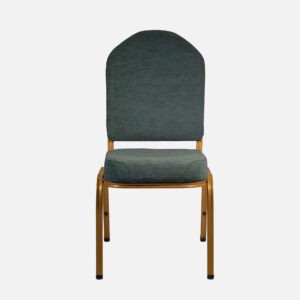
Church chairs are stackable or interlocking seats built for worship spaces, usually with a steel or aluminium frame, moulded foam and a linking system. Judge church chairs on frame gauge, foam density, stacking height and how the ganging clips behave after a thousand cycles. Comfort over ninety minutes matters more than showroom appearance.
What church chairs are, and why this decision outlasts the committee
A church chair is contract seating designed for long periods of sitting, frequent rearrangement and decades of service. That description sounds close to a conference chair, and visually the two often resemble each other. The differences sit underneath.
Worship seating carries a heavier duty cycle than most buyers expect. A single chair holds an adult for roughly ninety minutes, then gets stacked, wheeled, unstacked and reset, sometimes twice on a Sunday. Multiply that across fifty-two weeks and two decades, and the linking clip becomes the part that decides whether the set survives.
The second difference is emotional rather than technical. Congregations notice church chairs in a way they never notice office furniture. Colour, back height and the sound a chair makes when it moves all become subjects of conversation. So a specification that reads well on paper can still fail on its first Sunday.
Because the purchase repeats so rarely, most committees have no institutional memory to draw on. The people who bought the last set have usually moved on, and the invoice tells you the price but not the reasoning. That absence of memory is precisely why cheap church chairs keep winning tenders and keep disappointing.
Throughout this guide we treat church chairs as a twenty-year commitment rather than a line item. That framing changes what you inspect, what you refuse and who you buy from. It also changes the questions worth asking, because a trading company cannot answer most of them.
Church chairs or pews: the honest comparison
Almost every committee starts here, and the argument usually turns emotional before anyone checks a number. Both options work. They simply solve different problems, and the right answer depends on what your building does midweek.
Pews win on tradition, on visual continuity and on cost per seat in a fixed layout. They also win on durability in the crudest sense, because a solid bench has very little to go wrong. If your sanctuary hosts worship and nothing else, pews remain a defensible choice.
Church chairs win the moment the room needs a second job. Concerts, youth groups, community meals, funerals with different capacities and midweek meetings all demand a floor that can change. Once a room earns income or serves the community outside Sunday, fixed benches quietly cost the church more than they save.
The comfort comparison usually surprises people. Modern church chairs with correctly specified foam outperform an unpadded pew over a ninety-minute service by a wide margin. A padded pew closes the gap, though it also loses the cost advantage that made pews attractive.
We treat this comparison in more depth in our guide to choosing between pews and chairs, including the resale and heritage questions. For the rest of this guide, assume the decision has gone toward chairs.
Risk insight
Buying church chairs in two batches years apart is the most common and least recoverable mistake we see. Foam suppliers change, fabric dye lots shift and frame tooling gets revised. Two batches of nominally identical church chairs, bought three years apart, will not match under sanctuary lighting. Order your full projected count at once, or confirm in writing that the manufacturer will hold your exact specification and dye lot for reorders.

The types of church chairs you will be quoted
Suppliers build worship seating from a fairly short list of families. Knowing the list makes quotations comparable, because you can force every vendor onto the same grid. Without it, you end up comparing a wooden frame against a stacking steel one and learning nothing useful.
Each family below suits a different building. None of them is universally better, whatever a catalogue implies. Read them against your own room, your storage and how often the floor changes.
One rule cuts through most of the noise. Ask what the chair does when the room changes. A chair that stacks and links suits a room with many jobs. A chair that does neither suits a room with one.
Price ranges overlap across the families, which confuses buyers further. A heavy wooden frame can cost less than a well-built steel one. So the family name tells you little about quality on its own.
Weight is the honest sorting tool. Pick up the sample yourself. If one volunteer cannot carry two church chairs at once, your room will not get reset often. Then the flexibility you paid for quietly disappears.
Finally, check what the supplier actually makes. Many sellers list all four families and build none of them. A factory that welds its own frames can change a dimension for you. A trader can only change the photograph.
Keep the shortlist short. Two or three families of church chairs, judged side by side, beats a catalogue of thirty. A long list flatters the supplier and paralyses the committee, and church chairs chosen by exhaustion rarely please anyone.
Stacking church chairs
Stacking models dominate the market, and for good reason. They stack four to twelve high depending on frame geometry, they move on trolleys and they let a sanctuary become a hall in under an hour. Most churches that buy chairs buy these.
The stacking height matters more than the brochure suggests. A chair that stacks ten high needs a storage bay with clearance and a floor that tolerates the load. Ask for the stacked height in centimetres at your chosen count, not just the count itself.
Watch the stacking bumpers too. Cheap church chairs use small plastic studs that wear through within a few years, after which every stack scuffs the chair below it. Better designs run a continuous glide or a moulded shoulder that spreads the contact.
Weight is the other constraint. Volunteers stack these, not professional crews. Anything above roughly six kilograms per chair starts producing complaints from the people who reset the room, and complaints eventually become a chair that never gets moved.
Test the stack before you buy, not after. Ask the supplier to stack ten church chairs and leave them for a week. Then look at the top surface of the bottom chair. Marks after seven days mean marks after seven years.
Also check how the stack behaves on a trolley. Some frames nest tightly and lean once they move. A stack that sways is a stack that gets dropped, usually onto a stone floor.
One more point on volume. Stacking church chairs make noise when they separate, and a hall resetting during a service next door will hear it. Felt-faced bumpers cost almost nothing and solve the problem for the life of the church chairs.
Interlocking and ganging systems
Fire regulations in many jurisdictions require rows of loose seating to be linked. Interlocking church chairs solve this with clips, hooks or male-female sockets that join neighbours into a rigid row.
The mechanism deserves real scrutiny. Clip systems that rely on a plastic tongue snap eventually, usually in the middle of a busy season. Steel hook-and-eye systems last longer but need alignment, so an untrained volunteer can leave a row half-linked without noticing.
Our preference, and the arrangement we build most often, uses a concealed steel link that engages by gravity when the chairs sit square. Nothing to press, nothing to snap. It costs slightly more per chair and removes an entire category of maintenance.
Ask whether the linking hardware ships attached or loose. Loose clips get lost during installation with impressive speed, and replacements rarely arrive quickly from an overseas supplier.
Order twenty per cent more linking parts than you need. They are small, cheap and easy to lose. Buying them later from an overseas factory takes weeks and rarely feels worth the freight.
Train two people to link a row properly, then let them show everyone else. Most linking faults come from habit, not from hardware. A row joined the same way every week lasts far longer than one joined by guesswork.
Try the links with gloves on. Winter halls are cold, and volunteers wear gloves. A system that needs fingertips will not get used properly, so the church chairs end up unlinked exactly when a full room makes linking matter most.
Wooden and hybrid church chairs
Solid wood frames answer the heritage objection. In a stone building with timber detailing, a beech or oak frame reads as belonging in a way that painted steel never quite manages.
The trade-offs are real, though. Wooden church chairs weigh more, stack lower and cost noticeably more per seat. They also respond to humidity, so a building with poor climate control will see joints loosen faster than the same chairs in a stable environment.
Hybrids split the difference. A steel frame with wooden arms, or a wood-effect finish on tube, gives much of the visual warmth at a fraction of the weight. Purists dislike them; treasurers usually do not.
If your building is listed or sits under heritage protection, check the approval route before you fall in love with a finish. Some authorities take a view on visible frame material, and finding that out after the order is an expensive lesson.
Ask about the joint, not the timber. Beech and oak both work. A mortise and tenon joint with a glued dowel holds for decades. A screwed butt joint under a stained finish does not, however good the wood looks.
Wooden church chairs also need a plan for repair. Frames get knocked, and a chipped edge shows immediately on timber. Ask whether the factory supplies touch-up stain in your exact finish.
Consider a mixed order as well. Wooden church chairs across the front rows, with steel-framed church chairs behind, gives the heritage look where visitors see it and keeps weight down where volunteers stack.
Pulpit, clergy and presider chairs
Almost every order includes a handful of chairs for the chancel. These sit apart, face the congregation and get photographed constantly, so they carry a visual weight far beyond their number.
Most churches specify a larger frame, deeper upholstery and often arms. Matching the fabric to the congregational church chairs ties the room together; deliberately contrasting it marks the space as different. Both approaches work when chosen on purpose.
Order these at the same time as the main run. A pulpit chair sourced two years later from a different maker will not match, and it sits exactly where everyone can see the difference.
Count them properly before you order. Most churches need between four and eight, covering clergy, readers, musicians and visiting speakers. Buying three and borrowing a fourth on busy Sundays looks exactly as improvised as it is.
Height is worth a thought as well. Chancel platforms raise the sitter already, so a very tall back can crowd the view of a screen or a cross behind. Check the sightline from the back row before you settle the model.
Keep one spare in storage. Chancel church chairs take heavy use and photograph badly once worn. A matching spare, held back from the original run, solves that problem for the life of the set.
Photograph them on delivery. Chancel church chairs get moved for concerts and weddings, and small damage accumulates unnoticed. A dated photograph settles any later question about wear, and helps if you ever claim on transit insurance.
Frames: steel, aluminium and solid wood
The frame decides how long church chairs last, and nothing else comes close. Everything else can be repaired or replaced; a failed frame ends the chair. So this is where a specification earns its keep.
Steel tube dominates because it combines strength with low cost. What varies is wall thickness. A 1.5 mm wall behaves very differently from a 1.0 mm wall, though both look identical once powder coated. When two quotations sit far apart on price, tube gauge usually explains most of the gap.
Aluminium costs more per kilogram and saves weight, which matters enormously when volunteers do the stacking. It also ignores humidity, so aluminium church chairs suit coastal buildings and unheated halls where steel eventually shows rust at the weld points.
Welding quality separates serious manufacturers from assemblers. Ask for photographs of the weld before finishing, not after. Powder coat hides a great deal, and a porous weld under a smooth black finish still fails in year eight.
Finish matters mostly at the feet. Glides wear through, and once bare tube meets a stone floor you get scratching and noise. Specify replaceable glides and buy a spares box with the order; they cost very little and disappear surprisingly fast.
One quick test needs no tools. Grip the front rail and twist. A well-built frame resists and returns. A thin one flexes and stays slightly out of true, which tells you how it will age.
Ask for the tube gauge in writing on the quotation. Suppliers who build good church chairs state it without hesitation. Suppliers who avoid the question have answered it.
Seat comfort and the ninety-minute test
Comfort in church chairs is measurable, and most buyers never measure it. They sit in a showroom for thirty seconds, decide the chair feels fine and sign.
Foam density does most of the work in church chairs. We specify moulded foam at 30 to 35 kilograms per cubic metre for congregational seating. Below roughly 25, the foam compresses permanently within two or three years and the chair goes hard in the middle where everyone sits.
Seat depth is the second variable. A depth of 42 to 45 centimetres suits most adults across a long service. Shallower seats push weight onto the thighs, deeper ones force people to slide forward and lose back support entirely.
Back angle matters more than back height. A backrest reclined four to six degrees from vertical relieves the lower spine without encouraging anyone to sleep. Perfectly upright church chairs look disciplined and become uncomfortable at around the forty-minute mark.
Run the actual test before ordering. Take a sample chair, sit in it for ninety minutes while doing something else, then stand up and notice what hurts. Three people should do this independently. It is the single most useful thing a committee can do, and it costs nothing beyond the sample.
Mini data
Foam is roughly eight per cent of the cost of a church chair and accounts for most comfort complaints after year three. Moving from 25 kg/m³ to 33 kg/m³ foam adds a small amount per seat on a typical order. Across three hundred church chairs that difference is real money, yet it is far less than reupholstering the same set in year six, which runs several times higher per chair once labour is counted.
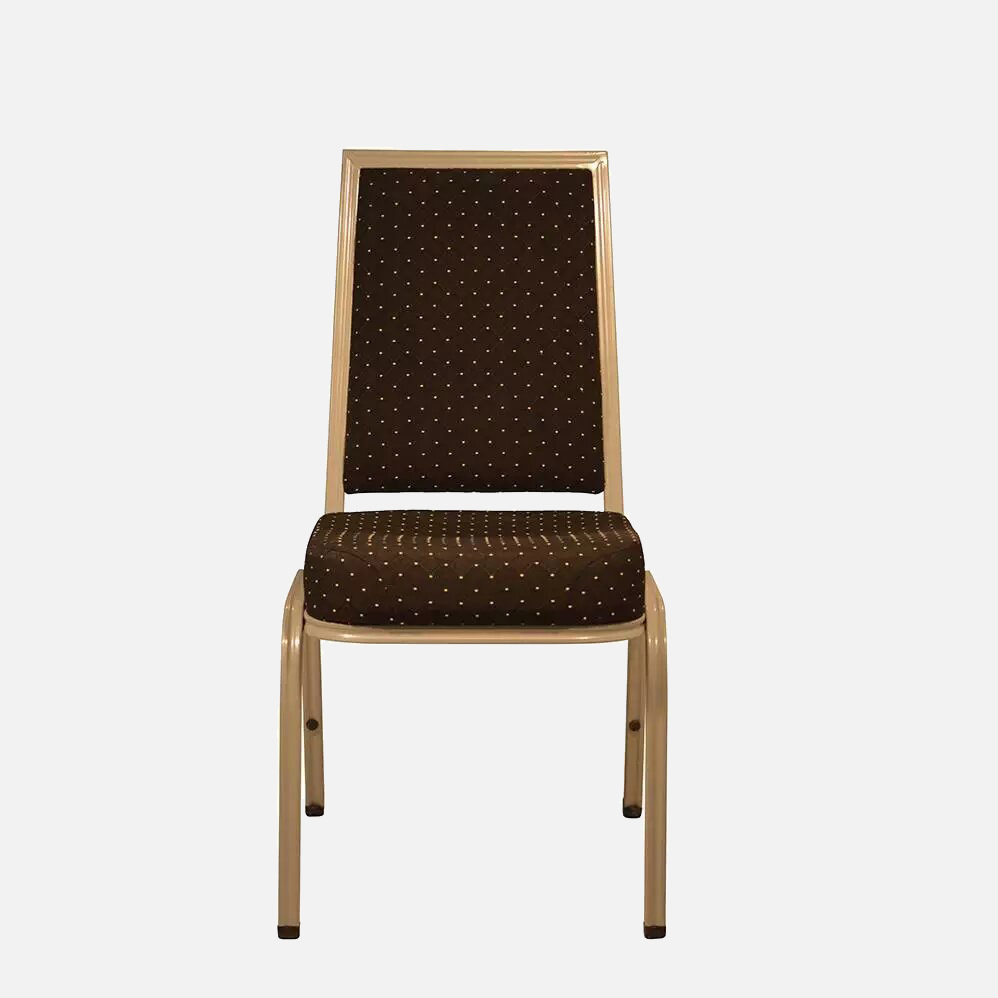
Upholstery: grades, cleaning and colour
Fabric is the part of church chairs that ages in public. Frames on church chairs fail quietly; upholstery fails visibly, and it does so at eye level in the middle of your sanctuary.
Abrasion resistance is the number to ask for, measured in Martindale cycles in Europe or double rubs under the American scale. Congregational seating should start at 40,000 Martindale. Anything below 30,000 belongs in a domestic setting, whatever the swatch book claims.
Cleanability comes next. Communion spills, children and coffee mornings all land on these seats. Fabrics with a stain-release finish, or a polyester content above roughly seventy per cent, tolerate cleaning without going patchy.
Colour is where committees spend the most time and the most goodwill. Two practical rules help. Mid-tones hide wear better than either very dark or very light fabrics, and any colour that reads as fashionable today will read as dated in eight years. Choose something you will still tolerate rather than something you love now.
Order spare fabric with the chairs. Five to ten metres, stored dry, lets you reupholster damaged church chairs from the original dye lot years later. Almost nobody does this, and almost everybody wishes they had.
Get large swatches, not small ones. A ten-centimetre square lies about how a fabric reads across three hundred seats. Ask for A4 samples and view them in your own sanctuary light, at different times of day.
Then sit on one. Some fabrics look excellent and feel warm or slippery after an hour. Comfort includes the surface, not only the foam beneath it.
Kneelers, book racks and communion holders
Accessories on church chairs look like details on a quotation and behave like structural decisions afterwards. Each one changes weight, stacking and price, so decide early rather than adding them later.
Kneelers matter in liturgical traditions and nowhere else. A folding kneeler adds weight and usually reduces stacking height, sometimes dramatically. Churches that stack weekly and kneel weekly face a genuine conflict here, and the honest answer is that you may need to choose.
Book racks on the rear of the backrest hold hymnals and bibles. They add cost per chair and make stacking slightly less dense. They also stop books piling on the floor, which most churches consider worth the trade.
Communion cup holders come as small moulded recesses in the rear rack or as a separate strip. They cost little and prevent a specific mess. If your tradition uses individual cups, specify them; retrofitting is rarely economical.
One caution applies to all three. Accessories attached with self-tapping screws into thin tube work loose over a decade of stacking. Ask how the fixing engages the frame, and prefer welded or through-bolted mounts on church chairs you expect to move weekly.
Decide accessories before you price the order, because each one changes the stack. A book rack alone can cost you two chairs of stacking height across a full trolley.
Think about who cleans them too. Racks collect dust, paper and forgotten items. A rack with an open base sheds debris; a closed one holds it, and somebody has to empty three hundred of them.
Stacking, trolleys and storage that actually works
Storage decides whether church chairs keep a sanctuary flexible. Churches that buy excellent church chairs and no trolleys usually stop rearranging the room within a year, which defeats the entire reason they chose chairs.
Start by measuring your storage bay, then work backwards. A chair stacking ten high at roughly 130 centimetres needs a door and a ceiling that accommodate a trolley carrying that stack, plus the person pushing it.
Trolley design varies more than buyers expect. Four-wheel dollies with a single vertical stack handle uneven floors poorly. Twin-column trolleys carry more per trip and steer better through doorways, though they need slightly more turning space.
Count the trips honestly. Three hundred church chairs at forty per trolley is eight trips out and eight back, before anyone straightens a row. Two trolleys halve the elapsed time and roughly halve the number of volunteers who quietly stop helping.
Protect the stacks as well. Fitted covers keep dust off upholstery in a hall that also hosts building work or catering. They cost very little and prevent the grey line that otherwise appears along the top chair of every stack.
Execution insight
Buy trolleys with the chairs, not after the first complaint. Trolleys usually add under five per cent to a church chair order and change the labour cost of every reset afterwards. Moving a stack by hand takes two people; a trolley makes it one, and turns a two-hour sanctuary reset into roughly forty minutes. Churches that defer trolleys almost always buy them within eighteen months, having lost a year of flexibility and several volunteers.
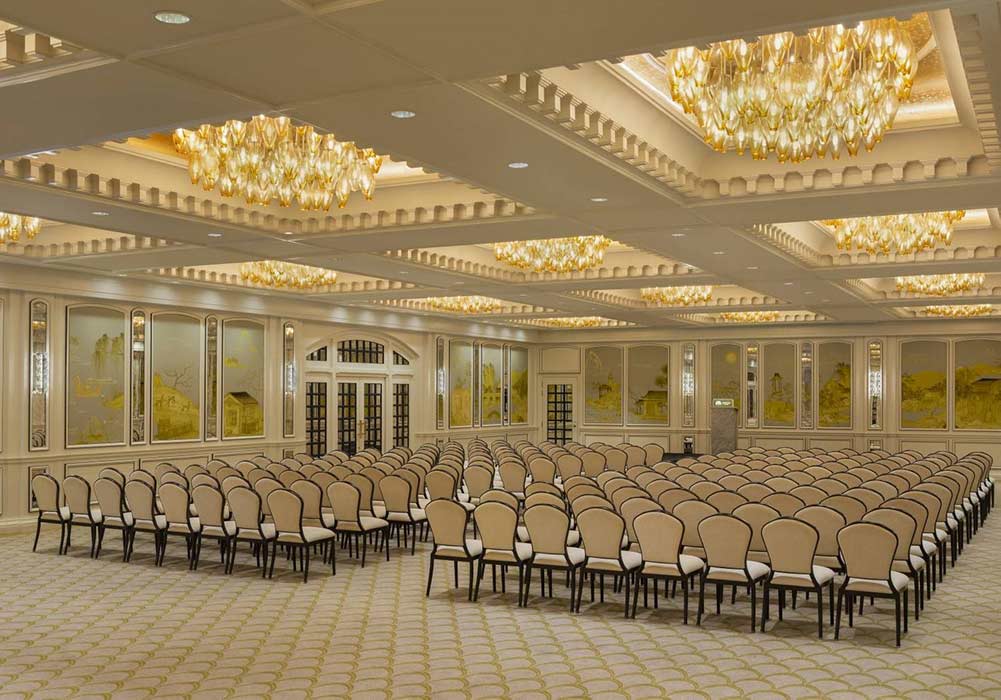
Flexible sanctuaries: what church chairs let you do
The strongest argument for church chairs is not comfort or cost. It is that a room full of them can become five different rooms, and a room full of pews can only ever be one.
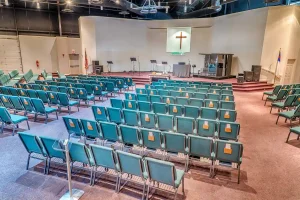
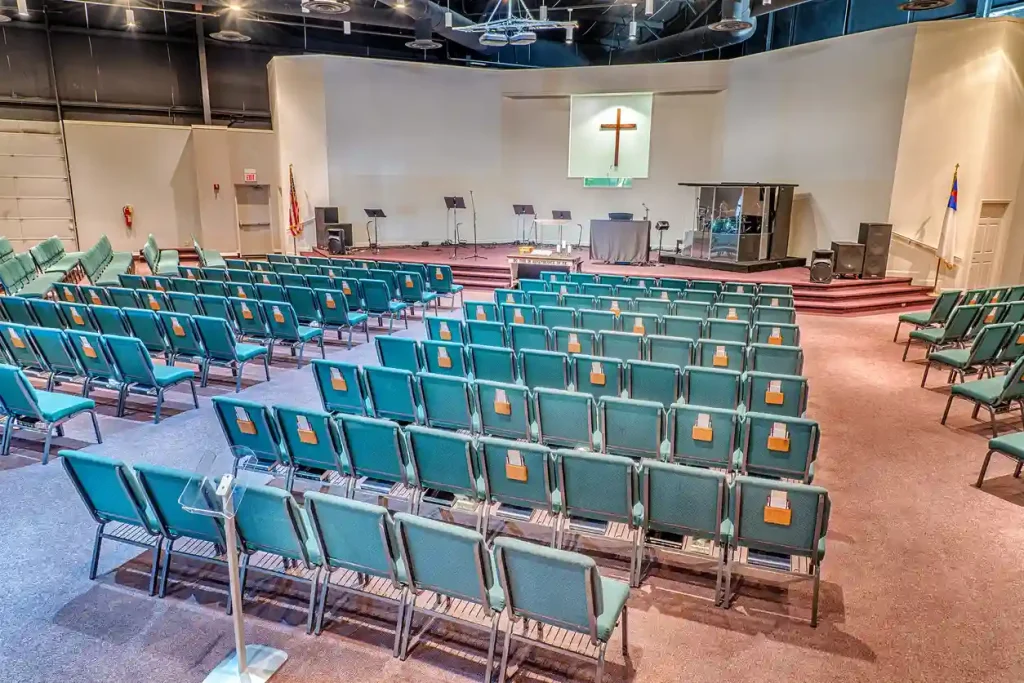
Theatre rows on Sunday, a semicircle for a smaller midweek gathering, a square for a study group, cleared floor for a community meal: each layout serves a different purpose and needs the same furniture. Churches that use all five recover the cost difference against pews quickly.
Layout also changes how a congregation feels. Straight rows read formal and focus attention forward. Curved rows shorten the distance from the back to the chancel and let people see each other, which smaller congregations usually prefer.
There is a limit worth stating. Rearranging weekly is realistic; rearranging for every event is not, unless you have reliable volunteers and good trolleys. Plan for two or three standard configurations rather than infinite flexibility.
We set out the practical geometry, including sightlines and aisle placement, in our guide to six church seating layouts. Read it alongside this page before you fix a chair count, because layout and quantity decide each other.
Agree the standard layouts and write them down. A simple floor plan taped inside the storage door removes all argument about spacing on a Saturday night. Volunteers reset faster when they are not guessing.
Floor markings help even more. Small discreet studs at row ends keep church chairs square without measuring. They cost very little and save perhaps twenty minutes on every reset.
Spacing, capacity and aisles
Spacing is where church chairs meet fire regulation. Most churches want more seats than the room comfortably holds, and the pressure to squeeze usually arrives late in the process.
As a working figure, allow 50 to 55 centimetres of width per person for congregational church chairs, and 90 to 100 centimetres from row to row measured back to back. Tighter than that and people cannot pass without everyone standing.
Row length drives aisle count. Many codes limit how many seats sit between aisles, commonly around fourteen for a row with aisles at both ends. Check your local requirement early, because it changes the chair count more than any other single rule.
Reserve wheelchair positions inside the seating rather than at the back. A clear space of roughly 90 by 130 centimetres, with a companion seat beside it, keeps families together. Achieving this simply means leaving out two church chairs in the right place.
Finally, resist filling every square metre. A sanctuary at ninety per cent capacity feels full and welcoming. The same room seated to its absolute limit feels crowded, and the extra rows get used four times a year.
Mark the plan with your row spacing before you order. Then walk it with a tape measure on the actual floor. Rooms are rarely as square as their drawings suggest, and columns eat seats.
Add one more check. Sit in the back row and look forward. If the chancel disappears behind the heads in front, raise the platform or curve the rows. Spacing that works on paper can still fail on sightlines.
Accessibility and fire safety
These two subjects decide whether your church chairs pass inspection, so treat them as constraints rather than preferences. They also overlap, because both concern how quickly people can move.
Linking is usually the first requirement. Many authorities require rows of loose seating above a certain size to be joined, which is why interlocking church chairs exist at all. Confirm the threshold locally, then specify linking hardware from the start.
Fabric and foam carry flammability requirements too. In the United Kingdom that means Crib 5 for public assembly; elsewhere the standard differs. Ask your manufacturer for the test certificate covering the exact fabric and foam combination you ordered, not a generic statement.
Accessible routes need width. Aisles serving wheelchair spaces should stay clear at a minimum of 120 centimetres in most guidance, and the route from entrance to space should avoid steps entirely. The Americans with Disabilities Act guidance gives a useful baseline even outside the United States.
Document all of this before installation. Inspectors ask for certificates, not assurances, and retrieving paperwork from an overseas factory eighteen months later is considerably harder than requesting it with the order.
Keep the certificates in one folder with the drawings and the order. Inspections happen years later, often under a different treasurer. A folder answers in ten minutes what an email search cannot answer at all.
Ask your insurer as well. Some policies for public assembly buildings refer directly to seating standards. A short call before ordering costs nothing and occasionally changes the specification.
Keep the fire certificate visible. Many buildings display it near the entrance with the capacity notice. It reassures visiting event organisers that the church chairs meet public assembly rules, which occasionally wins you a booking.
Standards, testing and what to ask a manufacturer
Standards separate church chairs that were engineered from church chairs that were merely assembled. Very few buyers ask about them, which is exactly why asking works so well as a filter.
For contract seating, EN 16139 covers strength, durability and safety for non-domestic use in Europe. In North America, the equivalent conversation happens around BIFMA standards for general-purpose seating. Either way, a real test report names the laboratory, the date and the specific model.
Ask for the report itself. A supplier who sends a certificate for a different model, or a quality-system certificate such as ISO 9001 in place of a product test, has answered a different question. ISO 9001 tells you the factory documents its processes; it says nothing about whether this chair survives 100,000 cycles.
Load testing deserves particular attention for stacking models. A chair rated for a static load may still deform when nine identical chairs sit on top of it in storage for a month. Ask specifically about stacked storage load.
Finally, ask what happens when something fails. A manufacturer who builds their own frames can send you a replacement part in year nine. A trader who bought a container from a factory that has since changed tooling cannot, whatever the warranty document promises.
Send the same brief to every supplier. Give the quantity, the fabric grade, the foam density and the linking type. Then compare the replies line by line rather than as totals.
Watch how they answer, not only what they quote. A factory that questions your foam choice is reading the brief. One that simply confirms everything is selling, not advising.
What church chairs cost, and where the money goes
Price conversations about church chairs go badly when the two sides mean different things. A quotation for church chairs can vary by a factor of three, and most of that variation is real rather than margin.
Roughly speaking, the frame accounts for about a third of the cost, foam and upholstery together another third, and the remainder covers linking hardware, finishing, packing and freight. Accessories sit on top. When a quote comes in far below the others, one of those blocks has been thinned.
The most common saving is tube gauge, because it is invisible. The second is foam density, which is invisible for about three years. The third is fabric grade, which announces itself in year five. None of these appear in a photograph.
Freight surprises churches more than any other line. Church chairs ship well when they stack, so a container carries a large number and the cost per seat stays modest. Chairs that do not stack, particularly wooden frames, can double the freight per unit.
Judge on cost per seat per year rather than on price. A chair costing thirty per cent more that lasts twenty years instead of eight is not expensive; it is roughly half the price. Committees that present the arithmetic this way usually get the budget approved.
How many church chairs your church actually needs
Buyers usually ask about quantity last, after the specification is settled. Answering it first would save a great deal of rework, because quantity changes what you can afford per seat.
Start from your regular attendance rather than your best-ever Sunday. Take the average across an ordinary quarter, then add roughly fifteen per cent for growth and visitors. That figure sets your standing sanctuary layout.
Then handle the peaks separately. Christmas and Easter often run at double normal attendance, and buying for those two days means storing hundreds of church chairs for fifty weeks. Most churches cover the difference by opening an overflow room or hiring.
Add a spares allowance of three to five per cent. Chairs get damaged, borrowed and occasionally lost. Ordering spares with the main run costs a fraction of what a small reorder costs later, and the colour will match.
Remember to count the chancel and any midweek rooms in the same order. Combining them raises the volume, which usually improves the price per seat and always improves consistency across the building.
Ordering church chairs from Turkey
Most churches buying at volume now import, and Turkey sits in a useful position between European standards and competitive manufacturing cost. Here is how the process actually runs.
Samples come first. Ask for a production sample in your chosen fabric, not a showroom chair. We send samples on request, and we expect committees to sit in them for a full service before deciding. A supplier reluctant to send one is telling you something.
Minimum order quantity for church chairs typically starts at fifty pieces. Below that, the setup cost per chair rises sharply and freight stops making sense. Most sanctuary projects clear that threshold comfortably.
Lead time runs around four weeks in production for a standard specification, plus shipping. Sea freight to northern Europe adds one to two weeks; to North America, four to six. Work backwards from your dedication date, not forwards from your order date.
Payment normally splits fifty per cent on order and fifty on completion, before shipment. Confirm the inspection point in writing: photographs of the finished run, or a third-party inspection, protects both sides. You can see current models on our church chairs range or send a specification through the quote form.
Confirm the packing method before shipment. Church chairs travel stacked, and stacked chairs rub. Corner protection and a fitted cover on each stack prevent almost all transit marks.
Plan the unloading too. A container of church chairs arrives on a lorry with a driver on a schedule. Three volunteers and a trolley turn that into an hour; two people without a trolley turn it into an afternoon.
Care, maintenance and realistic lifespan
Well-specified church chairs last fifteen to twenty-five years. Poorly maintained ones reach eight. The difference costs almost nothing and takes about an hour a quarter.
Check the linking hardware and glides quarterly. Both are consumables, both are cheap, and both cause damage when ignored. A worn glide scratches floors; a loose link lets a row wander out of line and puts stress on the frame.
Vacuum the upholstery rather than waiting for visible dirt. Grit in the fabric acts as an abrasive every time somebody sits down, which is why chairs in dusty buildings wear out at the seat front first.
Treat spills immediately with water and a mild detergent, then blot rather than rub. Most modern contract fabrics release stains easily within the first hour and reluctantly after a week.
Rotate the set annually if your congregation favours particular areas. Moving the back rows forward evens out wear across all your church chairs and can add several years to the point where the set looks tired. It takes one morning and costs nothing.
Write the checks into the church diary rather than trusting memory. Four short inspections a year, each about twenty minutes, catch nearly every problem while it is still cheap.
Keep a small parts box on site. Glides, links and a few screws cover most repairs. A chair sitting broken in a cupboard for six months usually needed a part worth very little.
Log every repair in one notebook. Over ten years that log tells you which church chairs sit under the worst use, and whether a batch shares a fault. It also makes the case for the next order far easier to argue.
Mistakes churches make, and how to avoid them
After enough church chair projects, the same errors repeat. None of them are foolish; each one simply comes from optimising the wrong variable at the wrong moment.
The first is deciding on colour before deciding on construction. Fabric is the easiest thing to discuss and the least important thing to get right, yet committees routinely spend three meetings on it and none on tube gauge.
The second is buying for the biggest possible Sunday. That decision inflates the order, drains the budget that should have gone into quality and leaves the church storing chairs it uses twice a year.
The third is skipping the ninety-minute test. A church chair that feels good for thirty seconds tells you nothing. Committees that sit properly in a sample almost never regret the chair they chose.
The fourth is treating the trolley, spares and spare fabric as optional extras to be cut when the quote comes in high. They are the cheapest insurance in the entire project, and cutting them is how a twenty-year set becomes a ten-year one.
The fifth is ordering before measuring the storage bay. It sounds obvious. Yet churches regularly discover on delivery day that their stacks will not pass through the door on a trolley.
The last one is buying from a photograph. Every church chair looks good in a catalogue. Ask for a production sample, sit in it, twist the frame and stack it. Ten minutes of handling tells you more than any brochure.
The sixth is letting one strong voice decide. Church chairs serve everybody, so gather three or four people to sit the samples independently. Agreement reached that way survives the first complaint; a single preference rarely does.
Where to go from here
The decision comes down to three numbers and one hour. The numbers are tube gauge, foam density and abrasion rating; the hour is the ninety-minute sitting test with a real production sample. Get those right and almost everything else follows.
Start by measuring your storage bay and counting your regular attendance. Those two figures constrain the chair more than any aesthetic preference, and knowing them turns a vague conversation with a supplier into a specific one.
Then read the layout guide alongside this page, because chair count and room arrangement decide each other. Once you have a layout and a quantity, request production samples from two or three manufacturers and sit in all of them.
When you are ready to compare real numbers, our church furniture guides cover layouts, spacing and the pew comparison in more depth. If you would rather start with a specification and a price, send us the room dimensions and your attendance figure through the quote form and we will come back with a drawing and a costed proposal.
Whatever you decide, remember who inherits it. The committee signs once; the congregation sits every week for twenty years. Specify for them.
Still deciding between fixed benches and loose seating? Read church pews vs chairs.
Frequently asked questions about church chairs
These are the questions building committees ask us most often. The answers below assume congregational church chairs bought in quantity for a sanctuary, rather than a handful of chairs for an office.
How much do church chairs cost per seat?
Church chairs vary widely by construction. A basic stacking steel frame with thin foam sits at the bottom of the market, while a heavier frame with 33 kg/m³ foam, 40,000-Martindale fabric and concealed linking costs considerably more. Judge cost per seat per year rather than the headline figure, since lifespan differs by more than price does.
Are church chairs more comfortable than pews?
Usually yes, over a full service. Correctly specified church chairs use moulded foam and a slightly reclined back, which relieves the lower spine across ninety minutes. An unpadded pew cannot match that. A padded pew comes close, though it costs more and removes the flexibility that makes chairs attractive.
How high do church chairs stack?
Most stacking church chairs stack between four and twelve high depending on frame geometry and whether kneelers or book racks are fitted. Ask for the stacked height in centimetres at your chosen count rather than the count alone, then check it against your storage door and ceiling before ordering.
Do church chairs need to be linked together?
Often yes. Many fire authorities require rows of loose seating above a certain size to be joined so a row cannot scatter during evacuation. Interlocking church chairs handle this with clips or concealed steel links. Confirm the local threshold before specifying, because retrofitting linking hardware later is awkward and expensive.
What foam density should church chairs use?
Specify moulded foam between 30 and 35 kilograms per cubic metre for congregational seating. Below roughly 25 kg/m³, foam compresses permanently within two or three years and the seat goes hard exactly where people sit. Foam is a small share of the price and the largest single driver of long-term comfort.
How long do church chairs last?
Well-specified church chairs last fifteen to twenty-five years with quarterly checks and annual rotation. Thin-gauge frames with low-density foam typically reach eight to ten. The frame decides the ceiling; foam and fabric decide when the set starts looking tired, and both can be renewed if the frame survives.
What is the minimum order for church chairs from a manufacturer?
Minimum order quantity typically starts around fifty pieces for church chairs. Below that, setup cost per chair rises sharply and container freight stops making economic sense. Most sanctuary projects clear the threshold easily, particularly when the chancel and midweek rooms go into the same order.
Can church chairs be reupholstered instead of replaced?
Yes, provided the frame remains sound and the manufacturer still supplies parts. Reupholstering costs a fraction of replacement and extends a good set by another decade. Order five to ten spare metres of fabric with the chairs so later repairs match the original dye lot rather than approximating it.